
I’m annoyed and frustrated. Some animals may be faster, others larger and more powerful, but human beings are by far the rudest animals in the forest.
I set out to hike the popular Sierra Buttes in the Tahoe National Forest. I was out early and had the trail to myself most of the morning. But by 10:00 am the trail was clogged with hikers, mountain bikers using hiking-only trails, tourists playing loud music, and four-wheel drive vehicles pushing people aside on the trail.
I need to get far away.
My Favorite Meadow
I have a favorite meadow in the Tahoe National Forest. It is reachable by a network of dusty Forest Service roads. The beauty and solitude of the place overwhelms me. It seems the perfect antidote to my chaotic morning.
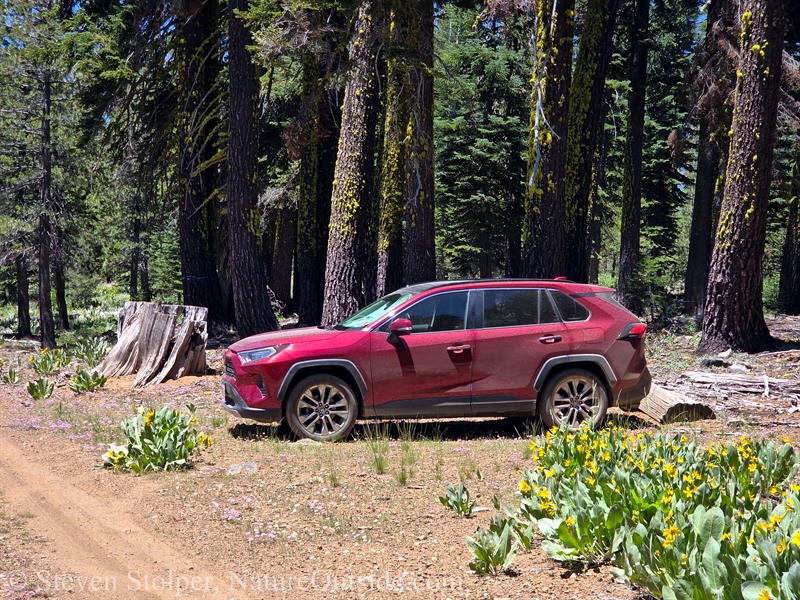
I parked at the edge of the meadow.
I leave my car parked at one edge of the meadow among the Mule Ears (Wyethia mollis) and Arrowleaf balsamroot (Balsamorhiza sagittata). I stroll into some nearby trees. My thought is to enjoy a picnic lunch in the shade of the trees with a commanding view of the wildflower-covered grassland. I will be able to observe any animals moving about while remaining concealed.
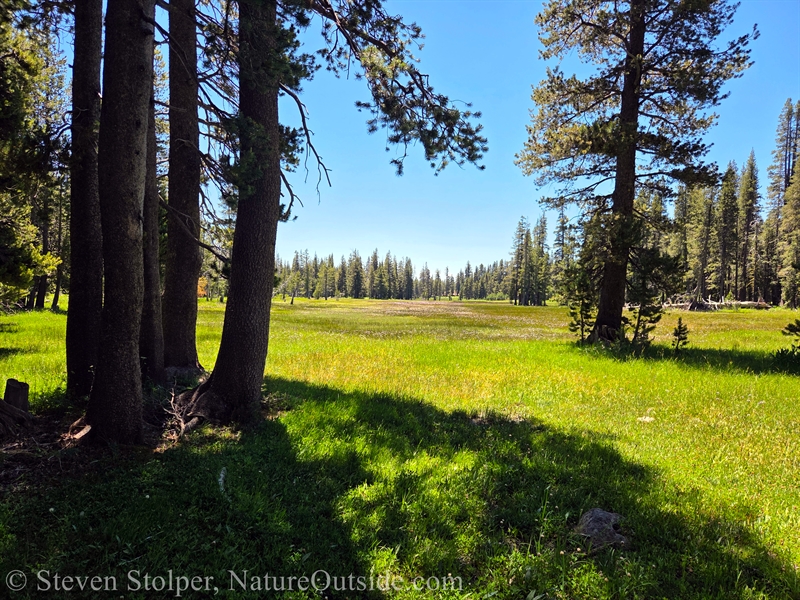
From my lunch spot, I have a commanding view while remaining concealed.
Critically, I leave my binoculars, camera, and bear spray in my vehicle.
It’s a glorious day. The summer sky is cloudless and the temperature is in the low eighties. Wildflowers cover the grass as the wet meadow still retains water from the winter snows. There is no wind and the scene has the quiet dignity of a painting.
I remember a quote from Walt Whitman:
Keep your face always toward the sunshine – and the shadows will fall behind you.
– Walt Whitman
The Big Brown Smudges
I plop down onto a fallen log and begin munching my sandwich. I scan the valley in front of me and start in surprise. There are three large animals foraging in the distance. And they’re brown!
I curse under my breath. The animals appear as large brown smudges in the grass. I’m worried.
A few days earlier I came upon an enormous American Black Bear (Ursus americanus). I wandered farther from my car than I had intended. And critically, I neglected to take my bear spray and knife with me. The encounter was peaceful, but it left me shaken. I had no defense against such a large animal. I might as well have been covered in Salsa!
Here I was making the same mistake twice! I squint into the distance to try and resolve the identities of the mystery animals. As I do, I realize that they are slowly working their way toward my position.
I walk determinedly back to the car. I am calm because I suspect the animals are not bears. But my unaided eyes cannot be certain. I’m already wearing my knife. But I retrieve my camera, binoculars, and bear spray from the car.
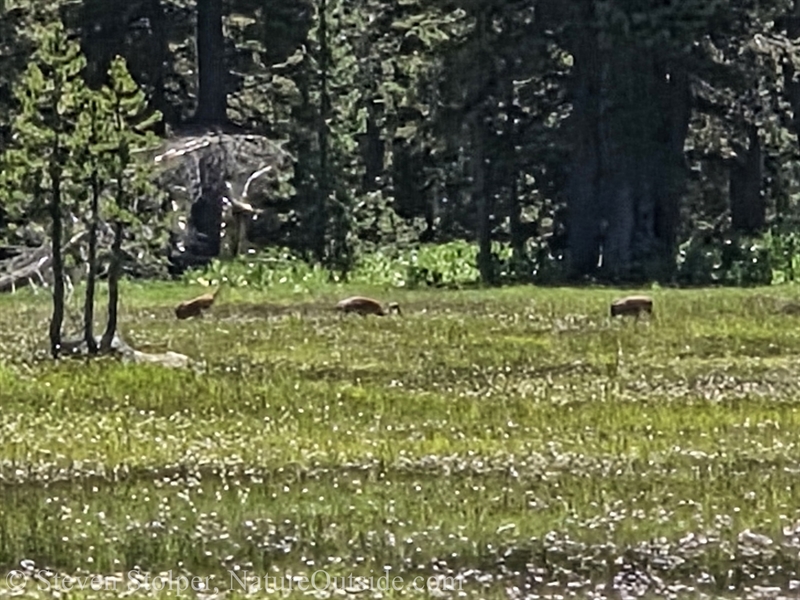
The brown smudges taken with my cell phone at maximum magnification.
Sandhill Cranes
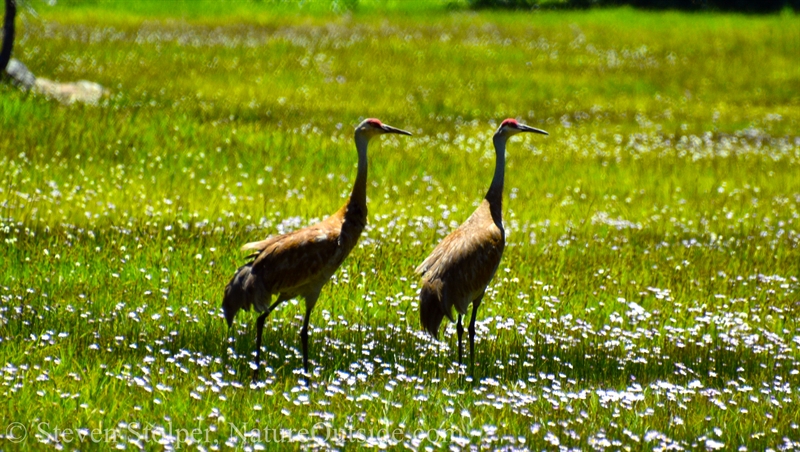
When I return to my lunch spot, I train my binoculars on the animals. And sure enough, they are not bears. They are Sandhill Cranes (Antigone canadensis).
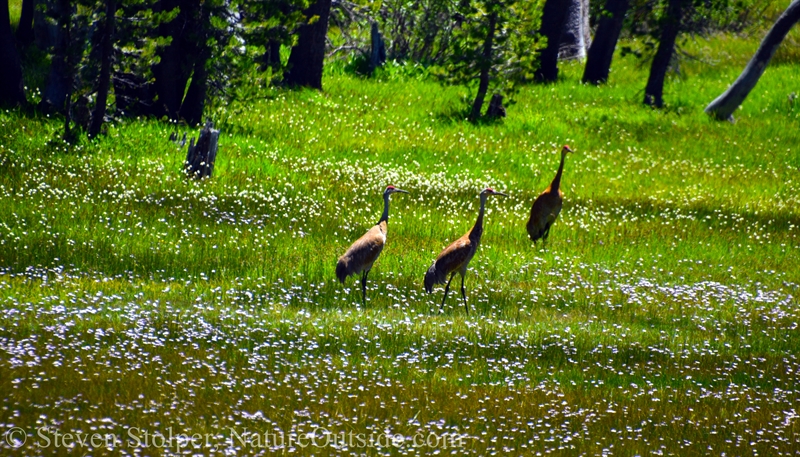
Three Sandhill Cranes foraging in the wet meadow.
Sandhill Cranes are tall, elegant birds. They have heavy upright bodies with long-necks. And with their long-legs, they look much like herons. They reach four feet tall and can have a wingspan greater than six feet. Throughout history these stately birds have inspired artists.
The cranes start breeding around seven years of age. And they mate for life, staying together year-round. This can mean that a pair of Sandhill Cranes can remain together for more than two decades. Juveniles stick close to their parents for about ten months after hatching.
Sandhill Cranes are famous for their dancing skills. Both male and female stretch their wings, pump their heads, bow, and leap into the air in a graceful and energetic dance. Seeing this display is one of my goals as a birder.
Sandhill Cranes inhabit open grasslands, meadows and shallow freshwater marshes. The meadow in front of me is perfect habitat.
Painting Behavior
If you read textbooks, they describe these birds as slate gray in color, with adults having a striking red patch on their foreheads. But here I describe the birds as brown. There is a reason for this.
A mating pair of Sandhill Cranes will preen iron-rich mud into their feathers. The mud acts as a natural dye. This is camouflage to blend in with brown, marshy vegetation while nesting. They remain this way while raising their young chicks. In the fall they will molt and return to their gray color.
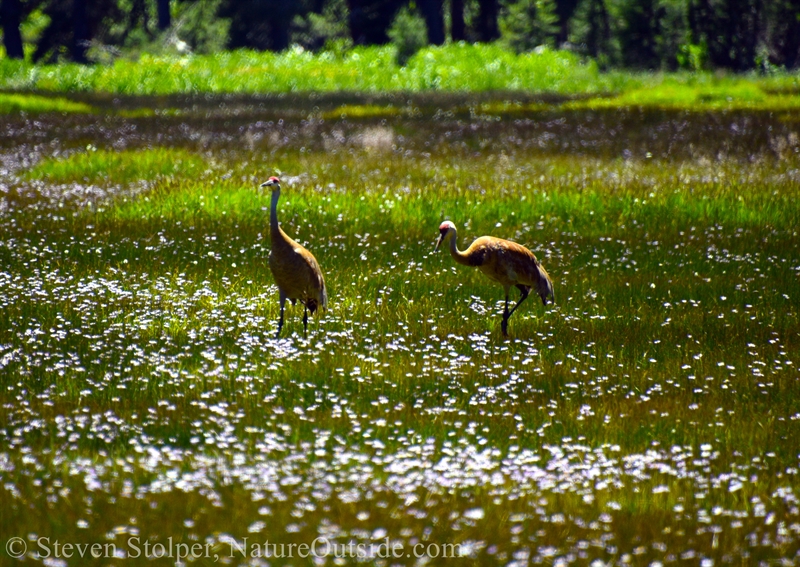
Sandhill Cranes paint themselves with mud to better blend in to their nesting area.
These three appear to be parents with a juvenile. The family group continues to graze as they approach my position in the trees.
A Covert Retreat
Before they get close, I pull back and return to my car. If they had discovered me, it would have doubtless unsettled them. When you stalk wildlife, you need to remain undetected to creep close. But a conscientious woodsman also plans a covert retreat to keep from startling them and changing their behavior.
The beauty of the meadow and the cranes is overwhelming. It proves that every step into the wild leads you closer to beauty.
References
Related articles on NatureOutside
The Robin’s Nest – How to Identify Bird Nests
Where do Birds go When it Rains?
To See More Wildlife, Learn Bird Language
For fun facts and useful tips, join the free NatureOutside Newsletter.

Leave a Comment