
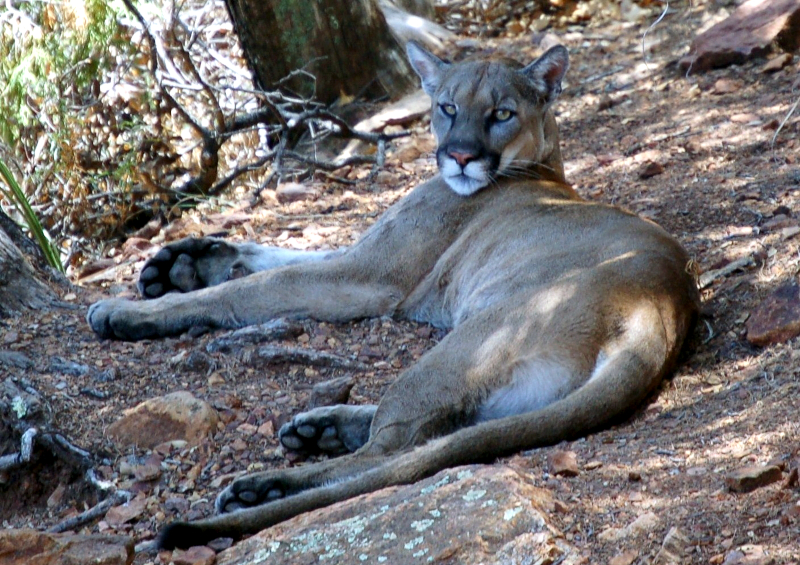
NPS Photo/Reine Wonite
I am fortunate to live in the San Francisco Bay Area. And most of my 8 million neighbors feel the same. One reason we are so enamored with the Bay Area is that we have ready access to the Santa Cruz Mountains.
The Santa Cruz Mountains form a ridge approximately 66 miles (106 kilometers) down the San Francisco Peninsula. They separate the Pacific Ocean from the San Francisco Bay and the Santa Clara Valley. They are not tall mountains. For example, the nearby peak of Black Mountain is only 2,812 feet (857 m) above sea level. But they are incredibly diverse. There are redwoods and oaks, coyotes and banana slugs, falcons and badgers.
There are also mountain lions.
A Guide for the Practical Mountain Lion
I’ve written before about mountain lion safety for hikers. I’ve also written about how to track mountain lions. But both these guides are for humans. I have been neglecting the mountain lion portion of my readership.
New research published in the journal, Current Biology, brings to light how mountain lions have changed their behavior due to humans recreating in the Santa Cruz Mountains. The research provides insight into how mountain lions react to human presence and how people can design trails in the future to accommodate lions. It also reveals a surprising fact about mountain lions that have become habituated to human activity.
I summarize this research below, in case any of the 50 – 60 adult mountain lions in the Santa Cruz Mountains are reading this. And if you are human, you may want to better understand mountain lion behavior.
The Research Methodology
The researchers are very clever. They had six years of high-resolution GPS data from 36 mountain lions in the Santa Cruz Mountains. They then obtained activity data from users of the fitness app Strava. By combining the lion and human activity data spatially and temporally, they were able to visualize how the lions moved with respect to the hikers, bikers, and equestrians.
Mountain Lion – Best Practices
The results were enlightening.
Mountain Lions proactively avoided heavily trafficked areas.
Most mountain lions proactively avoid heavily trafficked recreational areas, particularly within 98 feet (30 meters) of busy trails, and base their habitat selection on hourly trends in human use. They seemed to understand when areas are busy with humans and avoid these areas.
Mountain Lions Move More Quickly in Trail-dense Locations
Mountain lions move faster and more directly in trail-dense locations. This can mean that trail networks facilitate mountain lion movement. Or, that mountain lions avoid lingering in areas dominated by outdoor recreation.
High Exposure Mountain Lions Learned to Live with Humans
Some mountain lions with the highest exposure to recreation in their home ranges reduce their avoidance of people and become comfortable using habitats closer to trails.
High Exposure Mountain Lions Did Not Cause More Conflicts
Differences in habitat use among more human-tolerant mountain lions don’t seem to make conflicts with people more likely. Their reduced distance from humans did not result in more human-lion conflicts.
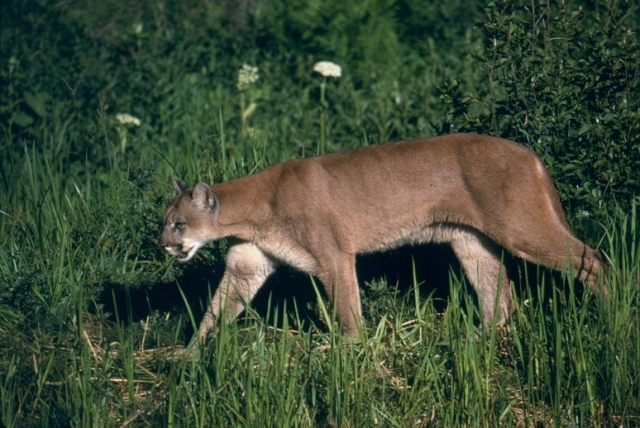
Photo by NPS
What Can We Learn?
Where We Build Trails affects Animals
There is growing recognition that human presence has widespread effects on ecological systems. And the study found that long-term patterns in hourly human trail use best explain mountain lion habitat selection and movement in the Santa Cruz Mountains.
The results build on a growing body of evidence that both human presence and human footprint have significant impacts on animal behavior. And that land management measures that affect patterns of human presence on the landscape may be one of the most effective ways to safely share spaces.
When we build our trails, we should be sure to provide habitat for wildlife away from heavily trafficked areas.
Killing Habituated Animals May be Wrong
Some mountain lions exposed to higher levels of recreation show progressively increasing tolerance of humans. This gives them an advantage – if they can use the areas that humans do, it increases the functional habitat in their territories.
The research findings challenge the commonly held assumption that human-tolerant lions are more likely to be responsible for conflict. This belief has driven management decisions such as killing human-tolerant individuals, which acts as an evolutionary pressure against habituation. But this may be misguided!
Lethal removal of human-tolerant lions can create a territorial vacancy in the carnivore population. The vacancy is likely to be filled by a younger, less-predictable, non-habituated individual moving into the area. This has the potential to actually increase human-lion conflict!
Thank you, Researchers and Funders
We should thank the Midpeninsula Regional Open Space District, which funded the study. The researchers are from UC Santa Cruz, Texas A&M University, Université de Toulouse, Panthera, Midpeninsula Regional Open Space District, and the California Department of Fish and Wildlife.
References
Current Biology, Volume 36, Issue 13, p3367-3373. June 16, 2026. Habitat selection and outdoor recreation help explain human-mountain lion conflict. John J. Morgan, K. Whitney Hansen, Nathan Ranc, L. Mark Elbroch, Matthew Sharp Chaney, Jason V. Lombardi, Christopher C. Wilmers.
Related Articles on NatureOutside
If you Meet a Mountain Lion – Safety Tips for Hikers
Mountain Lion Tracks – Learn to Read Them
For fun facts and useful tips, join the free Bushcraft Newsletter.


Leave a Comment