
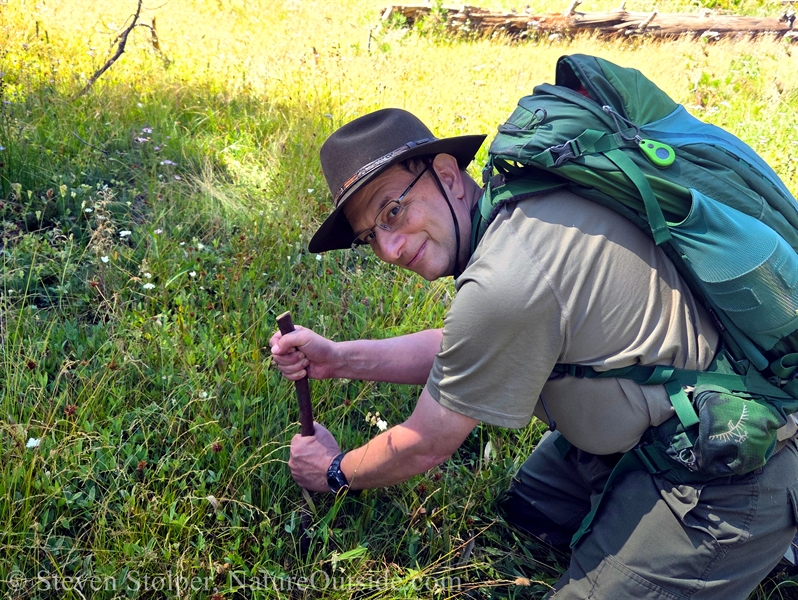
I like to forage for wild edible plants. I started with the leafy green aerial parts of plants. Then I learned to collect and process seeds. Eventually, I realized that some of the most protein and carbohydrate rich parts were underground. But to reach them, I had to learn to use a digging stick.
A digging stick is a traditional tool usually made from a single stick. The stick is used while kneeling or sitting to dig into the ground. Sizes (and uses) vary. But general-purpose digging sticks are about 3-4 feet (1 meter) long and about 1 inch (2.54 cm) thick. The stick usually has a pointed end, but many have a chiseled profile.
Don’t scoff at the digging stick! A digging stick may be more effective in hard or sun-baked soil than a shovel. You remove and lift less dirt with a digging stick than with a shovel. And you are not lifting large amounts of soil with your back. This equates to less effort to extract a bulb or root.
I certainly find this true when using a trowel to dig for underground parts of plants. With a trowel, I need to loosen the dirt and then lever it up for removal. Using a digging stick is less work.
The Digging Stick in California
Among native peoples, the digging stick had many uses. Digging sticks were used to harvest roots, bulbs, and corms as well as dig ovens, postholes, and even graves.1
The digging stick was vital for obtaining plant food sustainably. Digging sticks aerate the soil as you dig. They also break off small pieces of roots, corms, and rhizomes. This helps to renew the resource as you harvest it.
In many ways, the digging stick is superior to the tools of modern agriculture. Native Californians gently dug and maintained natural “gardens” without destructive plows, fertilizers, herbicides, and pesticides.
Traditionally, digging sticks were used by women, who did the majority of the foraging and gathering. But don’t let this deter you from using one! My masculinity is in no way diminished when I use a digging stick. I take pride in using a digging stick well. And I am usually excited to use the tool to get at wild edible food.
Materials for California Digging Sticks
Traditional digging sticks in California were usually crafted from hardwood. Mountain Mahogany (Cercocarpus betuloides) was a favorite material. Also used was manzanita (Arctostaphylos sp.), oaks (Quercus sp.), Catalina Ironwood (Lyonothamnus floribundus), and Toyon (Heteromeles arbutifolia). Buck brush (Ceanothus cuneatus) and Serviceberry (Amelanchier sp.) were also used for digging sticks.
The Chumash of southern California sometimes attached polished stone rings to give their digging sticks added weight.1
How to Make a Digging Stick
Once a digging stick is cut, it is usually fire-hardened. This can be done in various ways. It can be held over the fire. Or, the tip can be buried in the hot ashes of a fire (this excludes oxygen and keeps the wood from burning).
The purpose of heating the stick is to drive away moisture. This makes the wood harder and denser. It is analogous to tempering steel.
The Chumash held the tip held in a fire and then cut it to a point. They then held it in the fire again. Afterward, they soaked the tip in water before holding it in the fire a final time.1
I sharpen the stick before fire-hardening. And instead of a pointed end, I prefer a wedge shape like a modern chisel or crowbar. The shape allows me to dig with the edge as well as lever-out a clod of soil. I do this so I can verify the bulb I’m collecting is attached to the stem that drew my attention. This is a safe practice for harvesting underground plant parts when there are many species of plants growing together.
The Underground Parts of Plants
The underground parts of plants are often overlooked. But they contain some of the highest concentrations of carbohydrate and protein of any plant parts. You can use a digging stick to harvest tubers, bulbs, rhizomes, corms, and taproots.
Some you can eat raw. But most should be boiled, steamed, roasted, or baked in ovens. Many must be cooked to remove toxins or harmful chemical compounds. For example, Camus contains Inulin.2 Consuming too much inulin can cause nausea, bloating, and flatulence. Large quantities of inulin can also reduce how much sugar and cholesterol the body absorbs. Cooking reduces the amount of this polysaccharide.
Perennial wildflowers with underground storage organs grow throughout California. And they were an important source of food for nearly every group of Native Californians. There is little in the archeological record about consumption of underground plant parts because soft parts do not persist. But the botanist V.K. Chesnut (1867 – 1938) recorded that the Indians of the Mendocino area appended the word, “bo”, to the names of plants to denote the edible bulb, corm, or tuber of that plant.2 This indicates the importance attached to these foods.
These plants often have vegetative reproduction using their underground parts. This allows them to survive and reestablish in place after human disturbance. Native peoples would replant small roots, cormlets, and bulblets to ensure a continual supply of the resource into the future. You should do the same whenever you harvest underground parts of wild plants
Safety
There is more knowledge required to safely harvest and consume wild plants than I can put in this article. You must be able to identify the plant, know what parts are edible, know when to harvest the plant, and how to safely process the plant. You must also be able to evaluate the growing site to determine whether it is safe to eat the plant.
Do not harvest and consume wild edible plants unless you have this knowledge.
Plants in California with Edible Underground Parts
Here is a list of plants with edible underground parts that are commonly found in my area of California. You should do research to discover those in your area. Your research should include learning about the processing necessary to make the parts safe to eat.
In addition, learn which plants are common and which are threatened or endangered so that you do not denude the landscape. There are edible species that I choose not to harvest because they are already threatened by habitat loss.
Here are some edible plants in my area of northern California. Note that I make no mention of the processing required to make them safe.
Bulbs
- Brodiaea (Brodiaea sp.) – Bulb
- Camas (Camassia quamash) – Bulb
- Cat’s Ear (Calochortus tolmiei) – Bulb
- Ithuriel’s Spear (Tritteleia laxa) – Bulb
- Leopard lily (Lilium pardalinum) – Bulb
- Lewis’ lomatium (Lomatium triternatum) – Bulb
- Mariposa lily (Calochortus maweanus) – Bulb
- Ookow (Dichlostemma congestum) – Bulb
- Soaproot (Chlorogalum pomeridianum) – Bulb
- Wild hyacinth (Dichlostemma multiflorum) – Bulb
- Wild onion (Allium sp.) – Bulb
- Yampa (Perideridia sp.) – Bulb
Corms
- Blue Dicks (Dichelostemma pulchellum) – Corms
Rhizome
- Cattail (Typha sp.) – Rhizomes and bases of stems
Roots
- Shooting Star (Dodecatheon clevelandii) – Roots
Other Uses for a Digging Stick
Digging sticks were used by Native Californians for other purposes besides harvesting edible plants. They were used to dig roots for basketry. They were also used to dig earthen ovens and postholes for shelters and fences. They were even used to dig graves.
An unusual use of a large digging stick was to collect angleworms, which are edible. After rain made the soil moist. A large digging stick was thrust into the ground to a depth of about one foot. It was stirred around to agitate the earth. Worms would then surface in large numbers for a radius of two to three feet.1
How to Use a Digging Stick
A while back, I took a wild edible and medicinal plant class given by a local university. We had a special permit to harvest a small number of wild plants from federal land for educational use. I had used a digging stick before, but my classmates had not. It was surprising to see how much difficulty they had with it. Many were awkward and ungainly as they used a digging stick for the first time. Watching them struggle is what spurred me to write this article.
The short answer for how to use a digging stick: Use a digging stick in whatever way feels comfortable for you. People (and digging sticks) come in a variety of shapes and sizes. The trick is to find a grip and a motion that seems natural and efficient.
I grasp the digging stick about 8-10 inches above the point with my left hand. I grip the digging stick with my right hand (my dominant hand) 12-18 inches above my left. You would think it best to have your dominant hand as the lower one, but doing this feels “weird” for me. I find it natural to have my dominant hand on top.
Native peoples have been observed holding digging sticks in the way that I do. But I use this grip because it feels natural for me. I wonder if it feels natural for biological reasons or cultural ones. Because, if you think about it, my grip is similar to the way Americans hold a baseball bat. And we have been holding bats since we were young children.
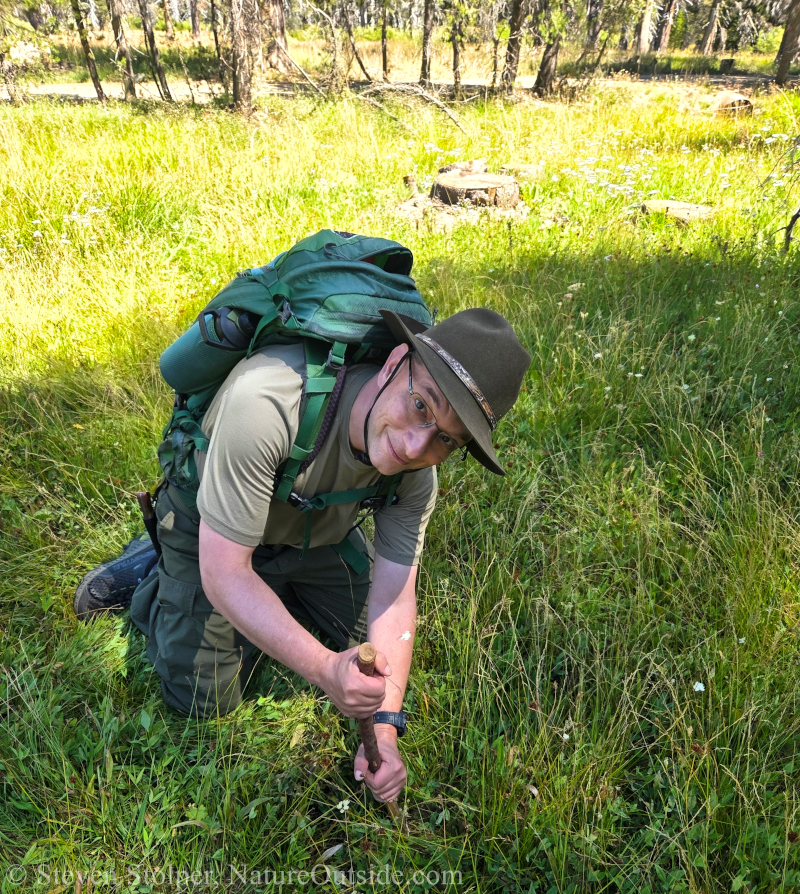
I hold the digging stick with my right (dominant) hand on top.
To use the stick, I thrust it into the ground and draw it towards me. It is remarkably like a paddling motion. Note that I am not exerting myself or trying to generate a lot of force. I am working with a rhythm and at a pace I can maintain all day.
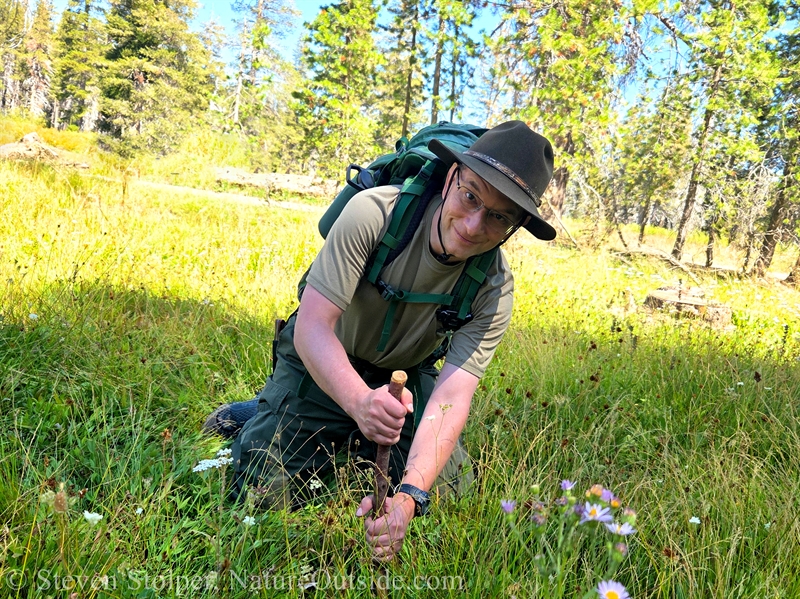
I draw the stick toward me using a “paddling” motion.
The Ethics of Using a Digging Stick
It appears that Native Californians had rules to be able to harvest large quantities of edible plants while perpetuating their populations:2
- Spare individual plants to allow future production
- Harvest after seed-set to ensure that seeds fall at the site
- Dig bulbs and corms so as to disperse bulblets and cormlets that will mature into future plants
- Replant bulblets and cormlets
- Leave a lower section of the tuber
- Weed around favored plants
- Burn areas in which the plants grow to reduce competition and recycle nutrients
We live in the modern world. And we should have our own ethics when harvesting wild plants.
Many of these plants are now uncommon. Habitat destruction from development, agriculture, and ranching have decimated populations of once common plants. In addition, there is no tending (including burning) by indigenous peoples to help propagate the species. As a result, many of the wildflowers with edible underground parts are threatened and grow only on protected public lands.
As a result, I rarely use a digging stick. I don’t wish to destroy plants that are becoming increasingly rare when my survival does not depend on it.
My solution has been to grow many of these plants myself. Often I grow them in containers on my patio, which gives me the benefit of observing them throughout their lifecycles.
Always comply with local laws and regulations. But more importantly, use restraint and sound judgment when deciding if you should harvest the underground parts of plants.
Use your digging stick wisely. And always be a good steward for nature.
References
Related Articles on NatureOutside
How to Get Yummy Sunflower Seeds from Wild Plants
For fun facts and useful tips, join the free NatureOutside Newsletter.

Leave a Comment