
If you enjoy communicating your love of nature to others, then you should consider becoming a nature interpreter.
Nature interpreters are educators who communicate the meanings and significance of the natural world around us. They use communication and storytelling to connect people to the environment. Their goal is to inspire others to appreciate and understand the natural world, leading to a desire for conservation. A good nature interpreter doesn’t just relay facts, he or she creates meaningful, often emotional, connections between their audience and the natural world.
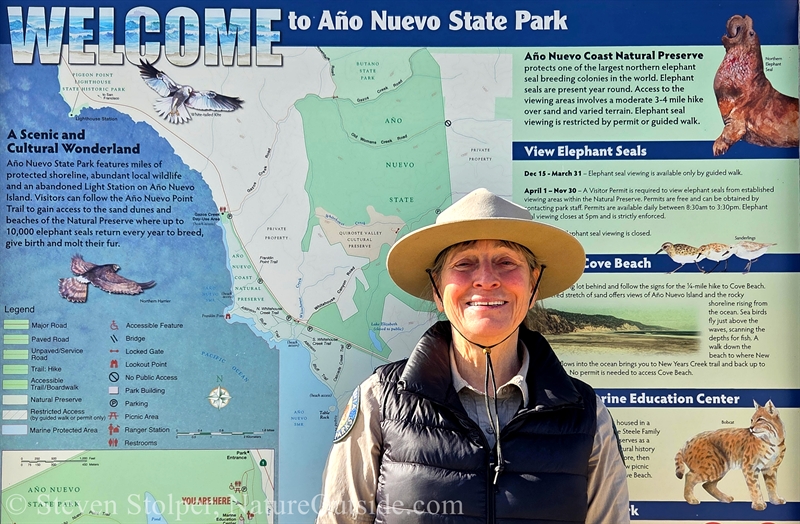
I had the opportunity to interview Susan Blake, the Interpreter I at Año Nuevo State Park, near Pescadero, California.
Susan, how would you define the job of an interpreter?
I think it’s communication. You’re communicating with a lot of different groups. You’re communicating with the public. You’re communicating with other staff. You’re communicating with volunteers and school groups. But it’s communicating. And it is helping to connect people to a resource, an idea, or a culture — depending on what your park is based on.
What do you like best about your job?
I like three things. And I think about this a lot.
I absolutely am delighted in my position that I’m out in nature so much. I just went out and walked to the point this morning. I try and do that every morning. And then, during seal season, I’m out there for hours, and I am just so grateful to be in a beautiful place. So being out in nature.
The second is working with docents. I love working with docents. I think it’s because we have a shared passion. Having that shared appreciation is just really wonderful. When we just go crazy talking, when we show our enthusiasm, they get it.
And with docents, especially new docents, being able to watch them get connected to this place and the love of interpretation.
And then the third is working with the public. I love seeing that growth (with docents) and so working with the public — It’s the same thing. Somebody’s not that enthusiastic about being outdoors or seeing these Elephant Seals. And you watch their eyes light up, it’s the quote about lighting a spark and it’s so true.
And so those are the three: Being outdoors, working with docents, and working with the public.
How did you come to be working for state parks?
Pure happenstance!
I think if I had known that this job existed before, that I probably would have chased after it. Although at the same time, I knew nothing about it. I had to be in it to see the delight and how well it connected with my loves.
I had been working at the Monterey Bay Aquarium for 16 years. My boyfriend was transferred and it sounded interesting to go somewhere, so it was right above big basin.
And as we were moving I thought, ‘okay, maybe I’ll go back to school.’ My dad was librarian. I was going to do library science or something.
But one of the Rangers at Big Basin would come and visit us and sit and talk. And I said, “are there any jobs available?” He said, yeah, you can be a park aid, and so I was a park aid for just about 2 months. And an interpretive position opened up. I had no idea what it was, but the ranger said I should apply. So I did, and I got it.
My boss taught at West Valley (college). She taught the interpreter class, and so I took the interpretive portion of the park management program and fell in love with it — got NAI certified.
Can you tell me what a typical day is like for you?
See, that’s a thing, there is not a typical day. And it can change so much.
You could be rescuing a Pelican, leading a tour, or doing a training class. Or you could be spending 8 hours on the computer answering Emails and scheduling docent training programs. You could be helping to find a lost person. You could be splitting firewood — there’s not a typical day.
So there’s not really an answer to that. And I love that! But in general each day there’s a lot of communication.
If you could change anything about your job, what would that be?
For a lot of us it’s the budget. And that’s not something that I can particularly change.
This office used to have up to five people. And now it’s basically two. But I think you’d hear that (the same concern) if you talk to a ranger, or a park aide, or to maintenance. It’s life with budgets being cut more and more, so sometimes that makes it a little hard.
But I’m not afraid of super hard work, so we’ve been able to roll with that. I really like my job. So, I can’t think of it (anything I would change).
What skills, knowledge, and abilities, would someone need to be an interpreter?
There are so many backgrounds. We’ve got teachers, engineers, consultants, and lawyers. I think a certain passion for the outdoors (is required). And for sharing information. You can be taught all about elephant seals. But that passion for it, I think, is what comes through. You need to have some caring in there.
How to communicate with people, and the different ways to communicate. It’s not about a lecture. It’s meeting the person (where he/she is).
It’s being able to Communicate in a way where you can connect with people. But you don’t have to have degrees in science. They come here with degrees in history, they come with degrees in philosophy, they can come with no degrees. It’s that part (communication) that is important.
What are some of the things that you don’t like about your job?
Not much. I really like my job. Sometimes there’s bureaucracy. And I’m like. “Leave me alone, but help me when I need it.”
Is it difficult to work with people and the public?
There’s always some difficulties. There are people who throw trash on the ground or people who bring dogs (when not allowed).
To be on a tour with a school group that is not paying attention at all, and that’s not necessarily their fault. It’s having to figure out how to connect, or just letting them have the experience they want. Maybe they’re not going be excited about elephant seals. But (playing in) that sand is fun!

Susan, doing a training with her volunteers.
I know you run a top-notch volunteer program. What is the secret to running a top-notch volunteer program?
Organization, which is kind of a strange thing. I do think it starts with passion. I love this job and I love the docents. And I think you need to have that you appreciate who they are.
There’s just so many different people, and so you have to be willing to meet docents where their personality is. So I think those two things: being accepting of people and organization.
Is there anything else you think people should know about being an interpreter?
I think that if it’s something you want to do, make sure you want to do it. If you think it’s your career, maybe try being a volunteer somewhere. And to become a permanent or something, there’s a lot of part-time positions (as a first step).
It’s not the job you get into where you want to have a ton of money. If you are looking for a life with lots of money, this might not be the position for you. So, look into that. But if it is what you want, I think it’s the best job!
Related Articles on NatureOutside
Give of your skills, even if you don’t think you have any!
The Tuibun of Coyote Hills (Part 1)
For fun facts and useful tips, join the free NatureOutside Newsletter.

Leave a Comment