
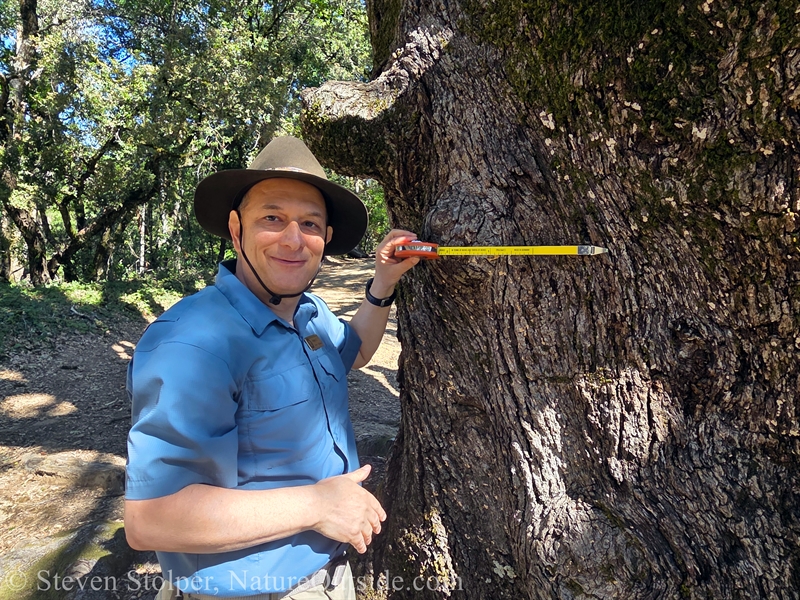
When I hike through a forest, I often wonder about the age of the trees. Trees are so long-lived compared to us humans!
Some of the hikes that I guide follow trails among giant redwoods that were alive during the Roman Empire. These trees are easy to identify because their branches blot out the sky and their trunks are wide enough to park a car inside.
But for the most part, I don’t really have a good way to estimate the age of trees I pass on my journeys. I’ve mentioned before how foresters measure the age of trees. But taking a core sample from a tree is a destructive process.
I wondered if there is a non-destructive way to estimate the age of a tree. And it turns out that there is.
The Formula
I am going to show you some simple math. Don’t be afraid! Later, I will show you a tool you can use to skip the math. But for the sake of completeness, we should try to understand the underlying theory.
The theory is that trees add growth rings each year. And although each tree is an individual, each species has a characteristic growth rate. Scientists have figured out the average annual growth rates for some tree species and have computed “growth factors” for them. We can use the growth factor for the species to estimate the age of a particular tree. The formula is based on the diameter of the tree, which we measure.
But we can’t measure the diameter of a tree directly without chopping it down and measuring a cross-section of the trunk! So, instead, we measure the circumference of the tree (at breast height) and use math to figure out the diameter.
Here is the formula:
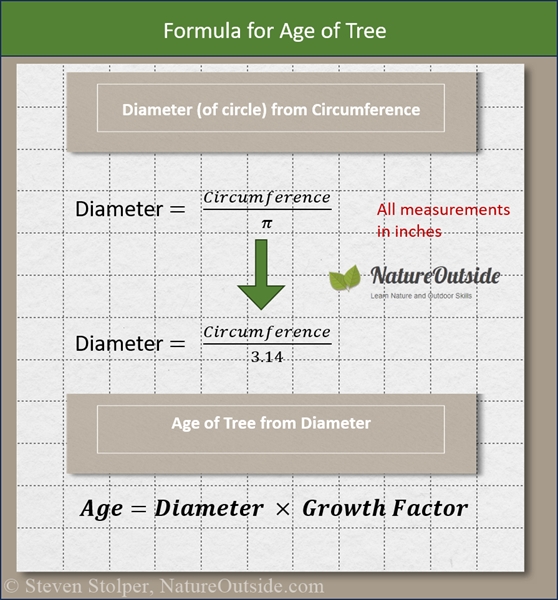
Here is all the math you need to estimate the age of a tree.
This formula gives you an estimate for the age of the tree. But all trees are individuals. So the estimates can be off by as much as five years.
The Measuring Tool
Rather than doing the math in the field, there are special tape measures (affiliate link) to help us. On one side it is a normal tape measure. But on the other, it gives us the diameter based on the distance (circumference) we measure. Since there is a consistent relationship between circumference and diameter, the tape measure can do this.
Here are some pictures of the special tape measure.
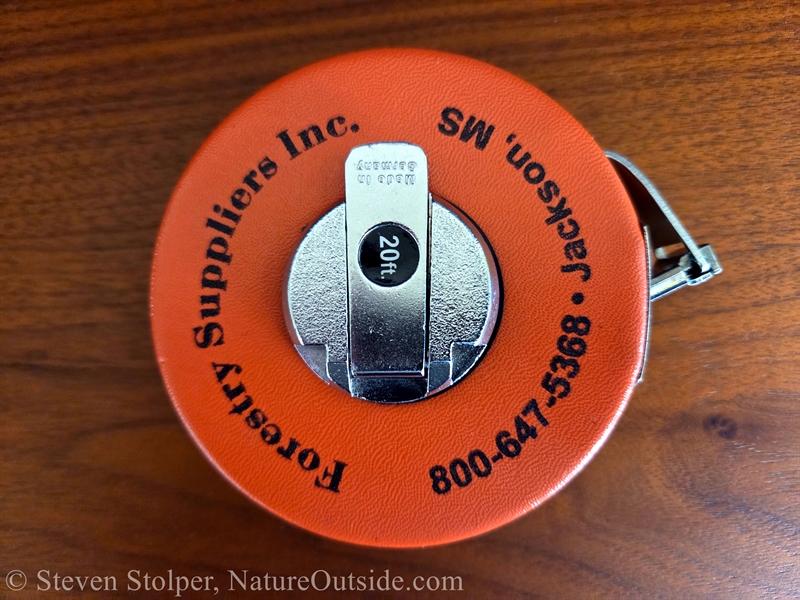
Tape measure with normal distance on one side and diameter on the other.
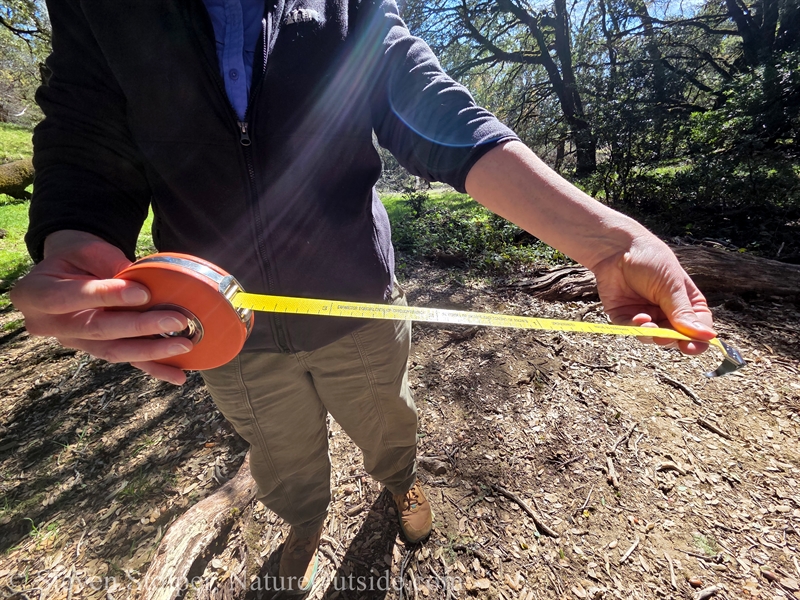
You use it like a tape measure, but it has a hook on the end to hold onto the bark of the tree trunk.
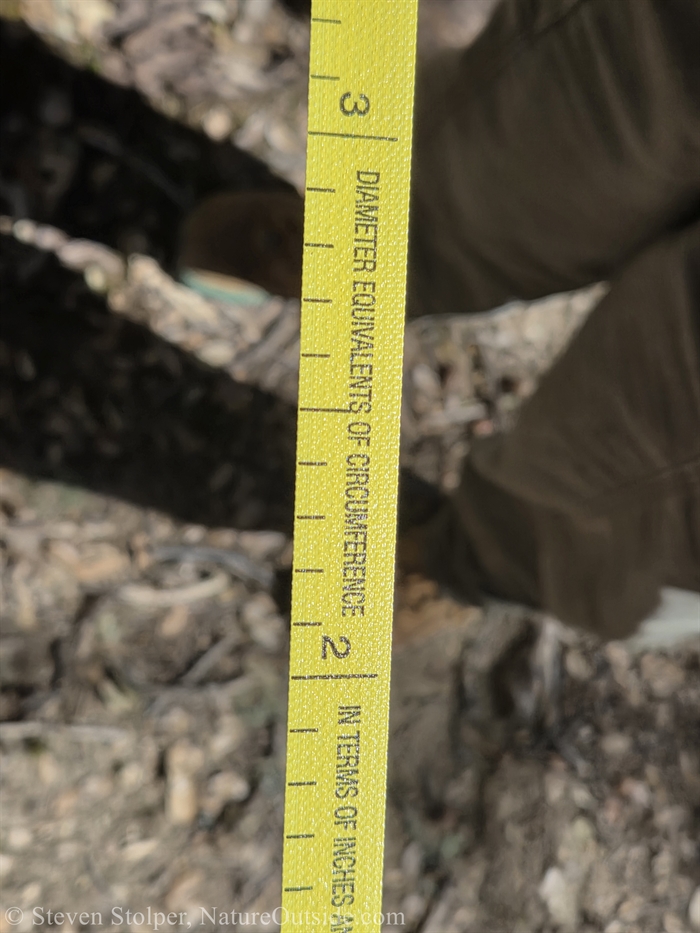
This side measures the diameter of the trunk in inches.
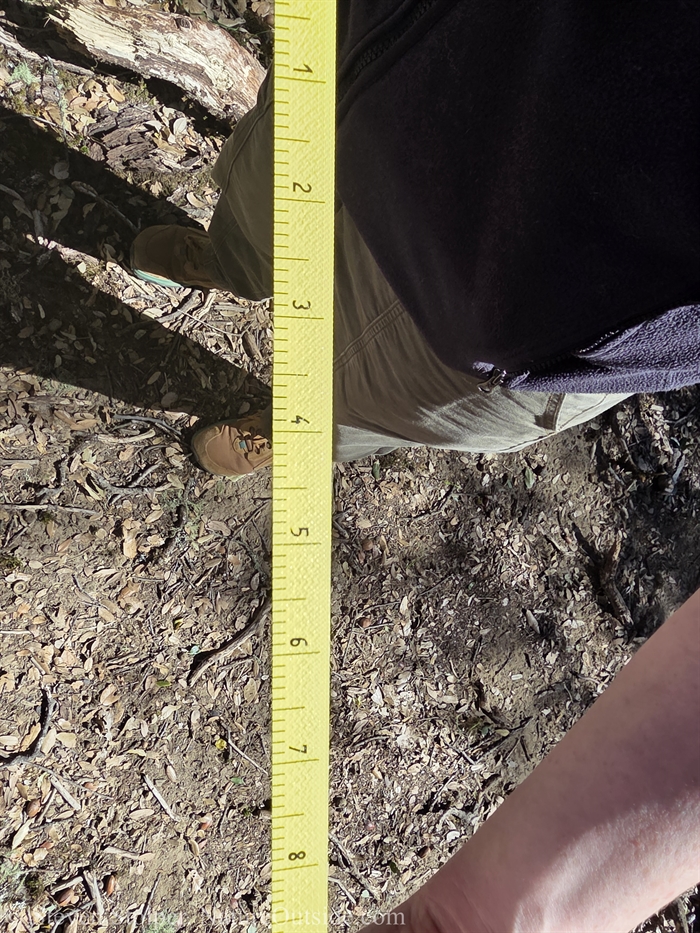
This side is a normal tape measure that measures distance/length.
You can get one for yourself here. For the purposes of estimating age, we use a tape measure for inches. For scientific use, people generally use the metric version of this tool.
The Canyon Live Oak (Quercus chrysolepis)
I got a chance to test out the tool on a hike I led for California State Parks. We hiked through caves, past a waterfall, and several large trees. Our small group was eager to try out the tool and try to figure out the age of the trees.
Our first tree is a Canyon Live Oak (Quercus chrysolepsis). These trees can range from 30 – 90 ft tall and 30 – 50 ft wide when fully grown. They are evergreen oaks that provide good size acorns. The tree is also called the “Golden-Cup Oak” for the color of the acorn cups.
How old do these trees get? According to the USDA, these trees grow slowly but at a relatively constant rate. The USDA believes that they can live for 300 years. But the University of California Agriculture and Native Resources website says that the upper age limits of these trees are not known. So we probably don’t know how old a Canyon Live Oak can get.
Our tree is a monster! It is huge and has grown over the top of a large boulder.
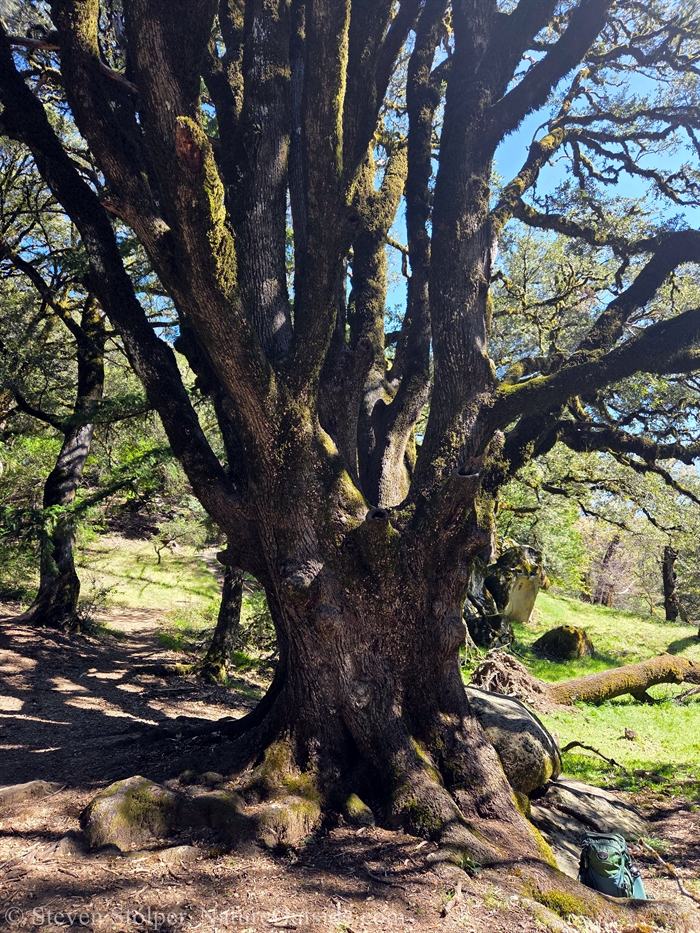
Canyon Live Oak.
The standard measurement we need to take is called Diameter at Breast Height, or “DBH.” To get DBH, we need to measure around the tree at 4.5 feet (1.37 meters) above the ground. If the tree is growing on a slope, we measure 4.5 feet above the ground on the uphill side. This can get tricky if you are a short person (like me!). Fortunately, we have people in our group to help.
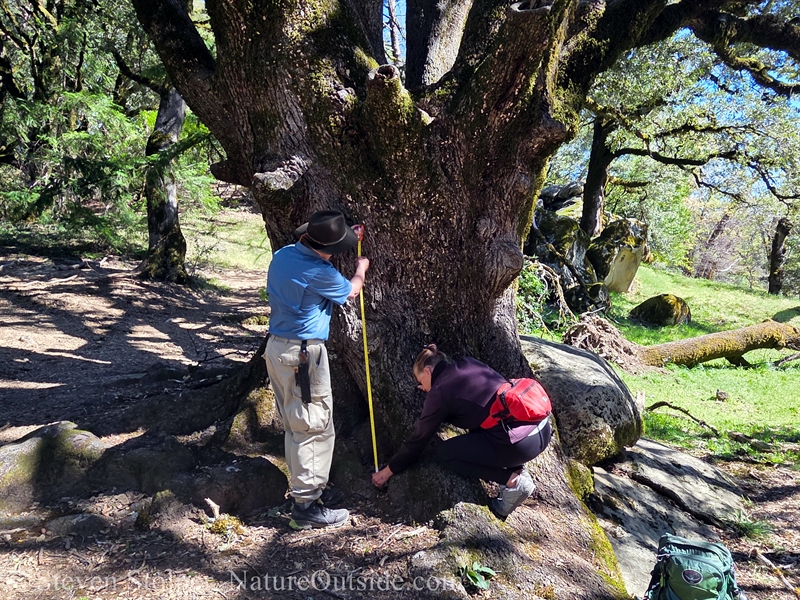
Measuring 4.5 feet above the ground.
Now we use the “diameter” side of the tape to measure around the tree.
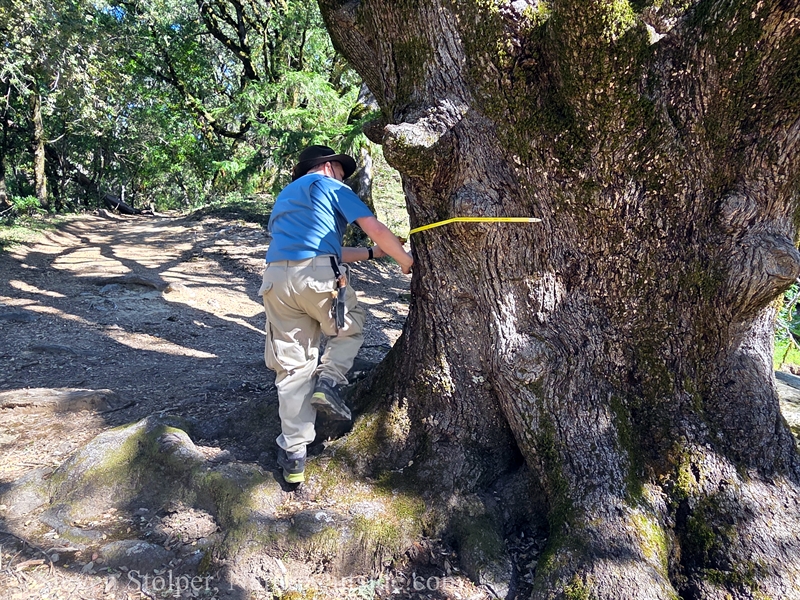
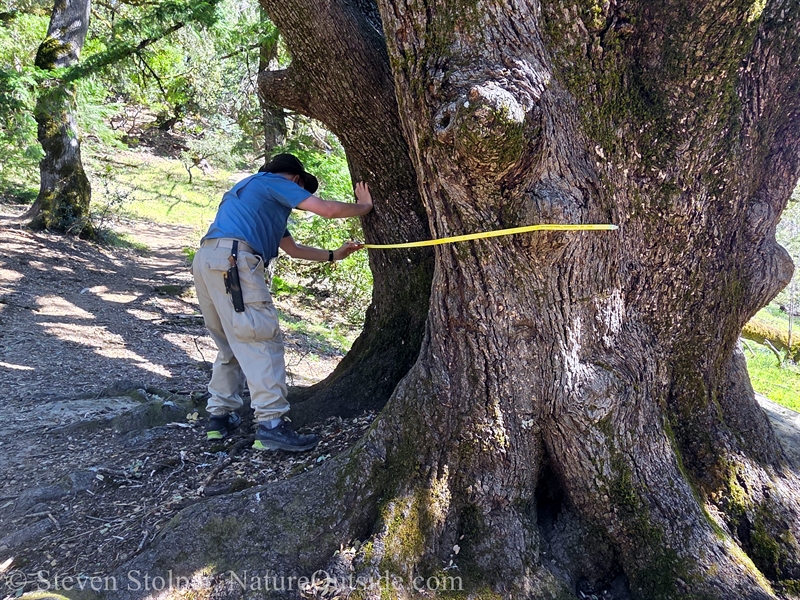
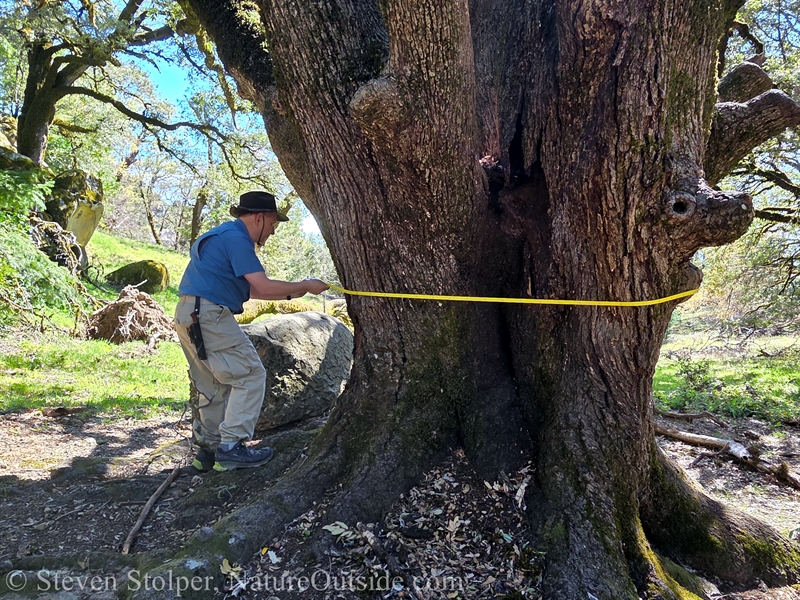
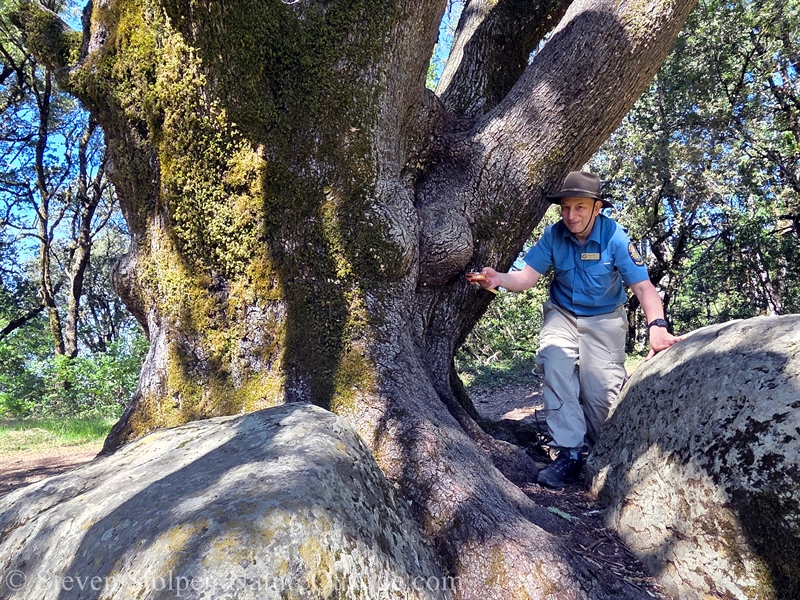
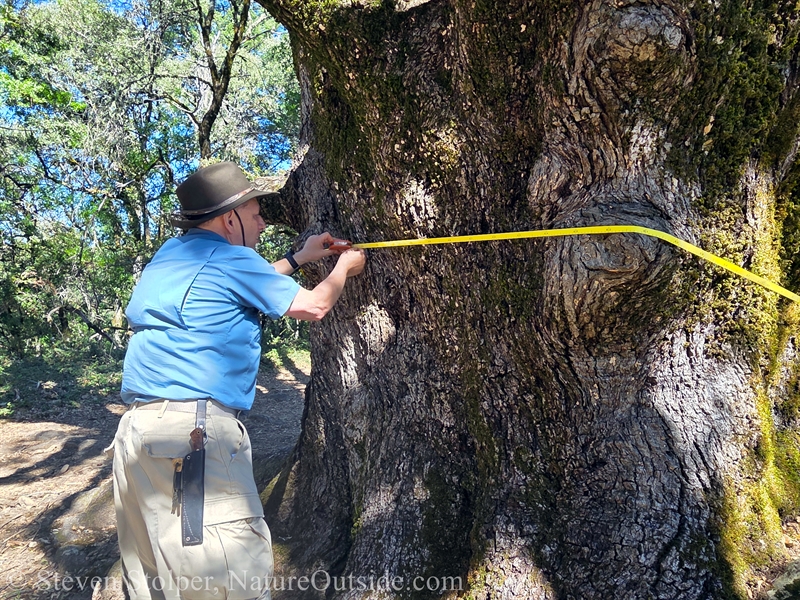
Thank you to Anne for helping to measure the tree and Hannah for taking the pictures!
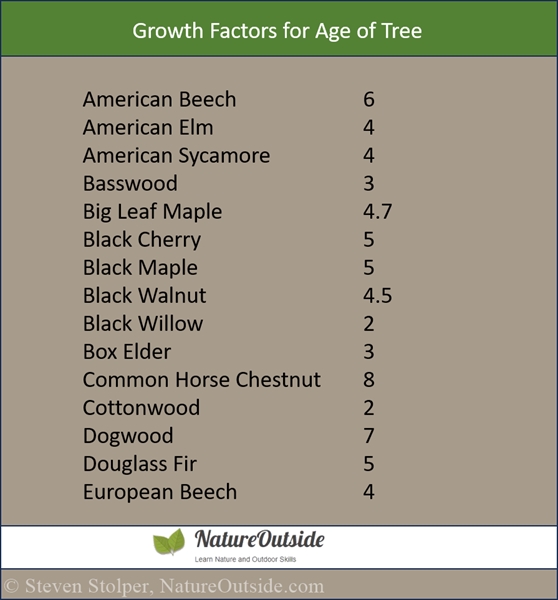
We measure a diameter of 74 inches. Using the growth factor (found in the table at the end of this article), we multiply the diameter by 4 to get an age of 296 years old!
The Douglass Fir (Pseudotsuga menziesii)
Toward the end of our hike, we encounter a gigantic Douglass Fir (Pseudotsuga menziesii). It is the perfect tree to estimate its age.
The Douglass Fir is an evergreen conifer native to the coastal regions of western North America, from central California north through Oregon and Washington to British Columbia, Canada.
According to the California Native Plant Society, Douglas Firs commonly live more than 500 years and occasionally more than 1,000 years!
The California Native Plant Society states that Douglas Firs are the second-tallest conifer species in the world after Coast Redwoods (Sequoia sempervirens). These trees can grow to 200-250 feet (60-75 meters) high and have trunks 5-6.6 feet (1.5-2 m) in diameter.
Here is our tree with me standing beside it.
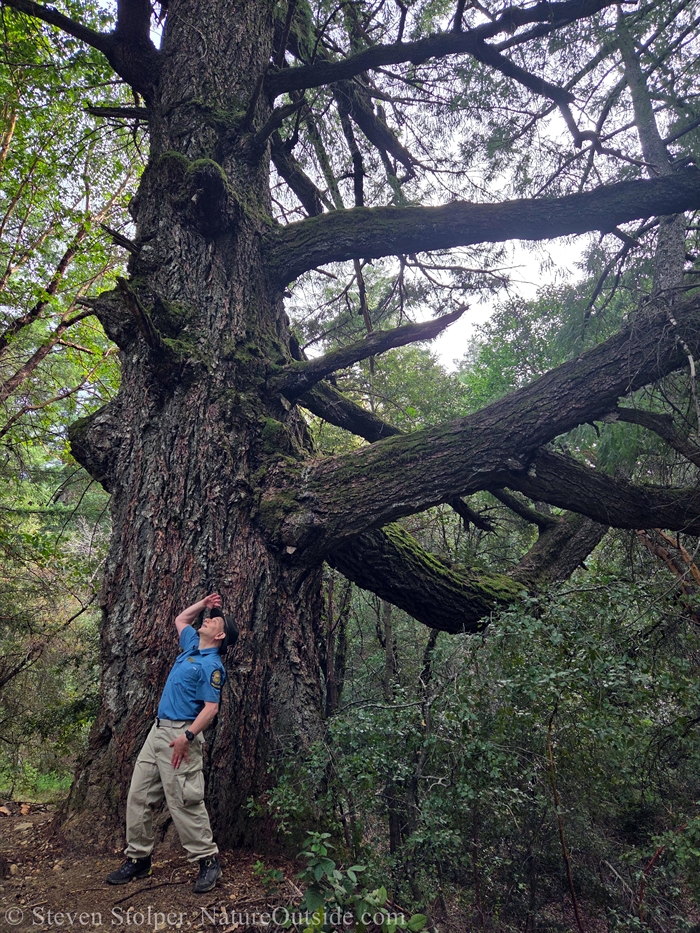
This Douglass Fir makes me feel like an ant.
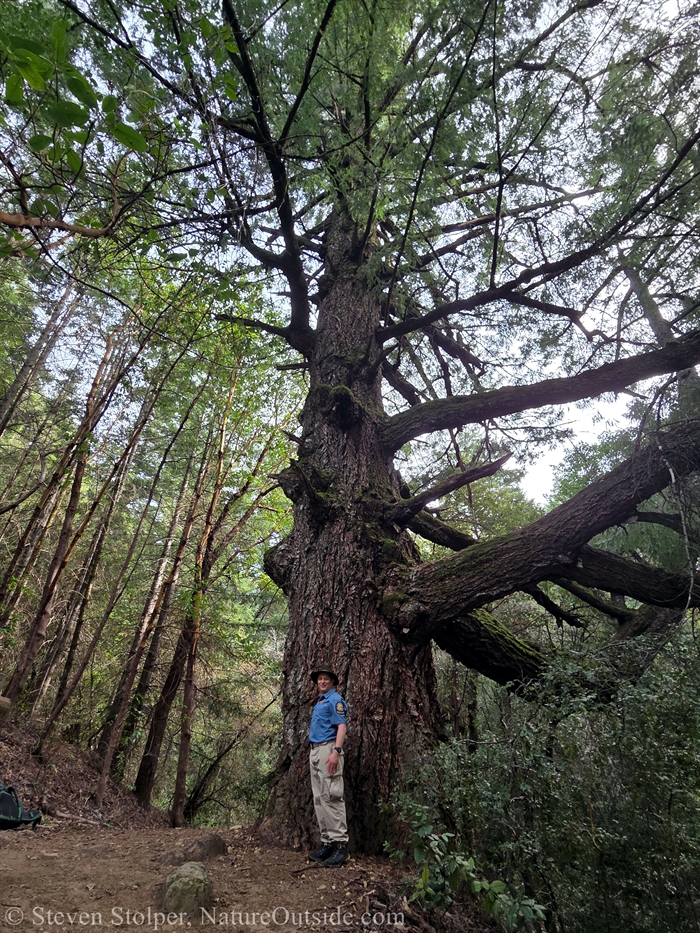
A spectacular Douglass fir (Psuedotsuga Menziesii)
We measure the diameter of the tree (DBH) at 75.5 inches. Multiplied by the growth factor of 5 (found in the table at the end of this article), we estimate the tree to be more than 377 years old!
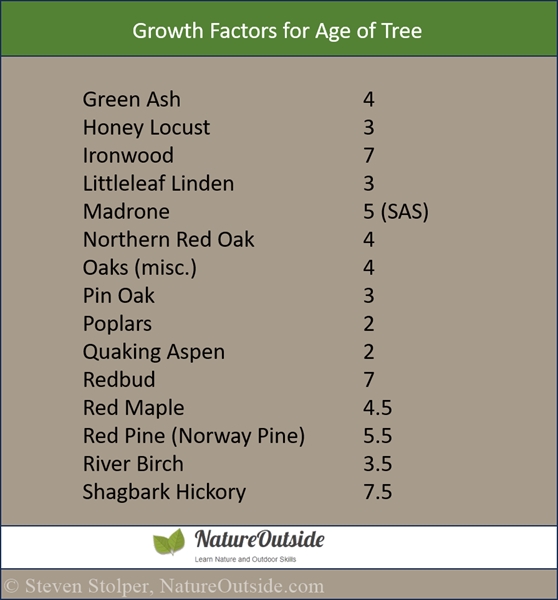
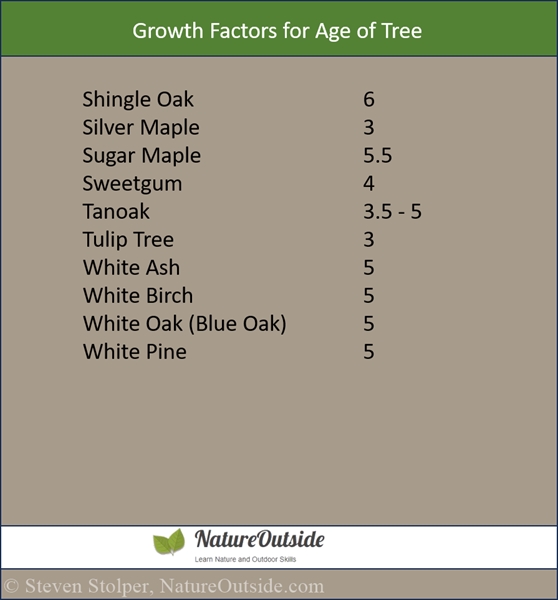
The Growth Factor Table
The growth factor is the magic that makes the estimation possible. Each species has its own growth factor. I have scoured the Internet for as many as I can find. And I discovered that there is no single authoritative source of growth factors. The growth factors I found were from academic papers, government agencies, and academic websites. I also found an academic paper that outlined the methodology for determining a growth factor of a species. I assume that all the published growth factors use this methodology.
The good news is that when I found websites that listed growth factors, they all seemed to agree. This makes me confident that the growth factors I will share with you are commonly accepted.
I assembled all the growth factors into the following set of tables. Note that I was unable to directly attribute many of the growth factors I found. Many people agree on them, but I could not trace them back to their sources.
Conclusion
Estimating a tree can be a lot of fun. I hope you can use the tools in this article to estimate the ages of trees near you.
Q: What do you call an old tree?
A: Elmderly
Related Articles on NatureOutside
For fun facts and useful tips, join the free NatureOutside Newsletter.


Leave a Comment