
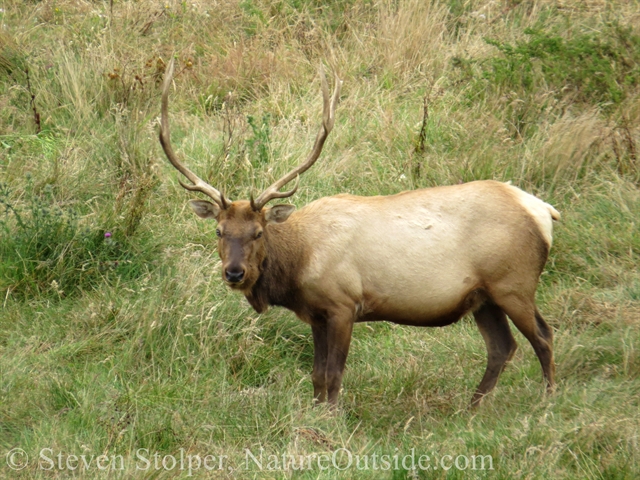
What are you looking at?
Never doubt that a small group of thoughtful, committed citizens can change the world; indeed, it’s the only thing that ever has.
– Margaret Mead
There is no doubt that modern society is damaging the environment. For example, humans now account for 36% of Earth’s mammal biomass. When you factor in our livestock and our pets, we account 95% of the global mammal biomass on planet Earth. Wild mammals now account for only 5% of Earth’s mammal biomass. Wild animals are in decline, and unless we change our course the outlook is bleak.
It can be done! And the story of the Tule Elk in California is an example of how people can make a difference to bring back a species we almost drove to extinction.
California Condors are the glamour models of California’s conservation success. But the Tule Elk are just as important.
What Is a Tule Elk?
Tule Elk (Cervus elaphus nannodes) is the smallest Elk in North America. Bulls can weigh up to 680 lbs. and cows up to 450 lbs. They generally stand 4 feet at the shoulder. Its smaller size may help the Tule Elk when food is scarce in the dry grasslands they inhabit. This routinely occurs during California’s dry Mediterranean summers.
Do not be deceived by their size! These are formidable animals. Tule Elk antlers can measure up to 5 feet long from their head to the tip of one antler. If you encounter a herd on one of your hikes, keep a respectful distance.
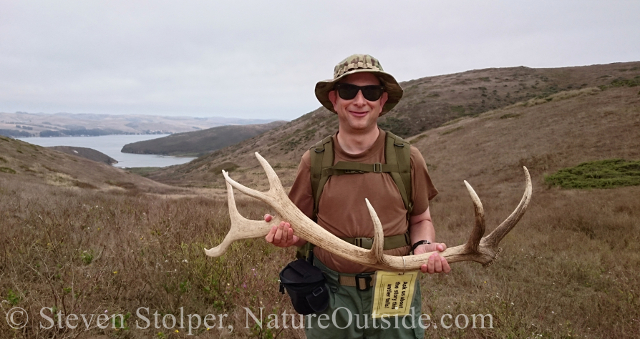
You get a feel for the size of these animals when you hold a shed antler.
What Happened to the Elk?
When people discover gold in California in 1848, there is a huge influx of people into the state. The residents kill the elk for food or to sell. They also drive them from their natural grazing areas, which the new settlers use for cattle. Since elk are viewed as competitors for their cattle, ranchers routinely shoot them.
In 1873, California passes a law that makes it a felony to hunt elk between March 1 and August 1. It also prohibits the sale of elk meat. This takes away a big financial incentive to kill the animals. But it is too late! By 1872 (a year before the law passes), Tule Elk are thought to be extinct.
A Lucky Break
In 1875, a rancher named Henry Miller changes the future (and our present). He discovers several Tule Elk hiding in a swamp at the south end of his ranch near Buttonwillow, California. Instead of shooting them, he orders his employees to protect the elk.
By 1923, the herd grows to 400 animals! Most, if not all, of the Tule Elk alive today are descended from those animals.
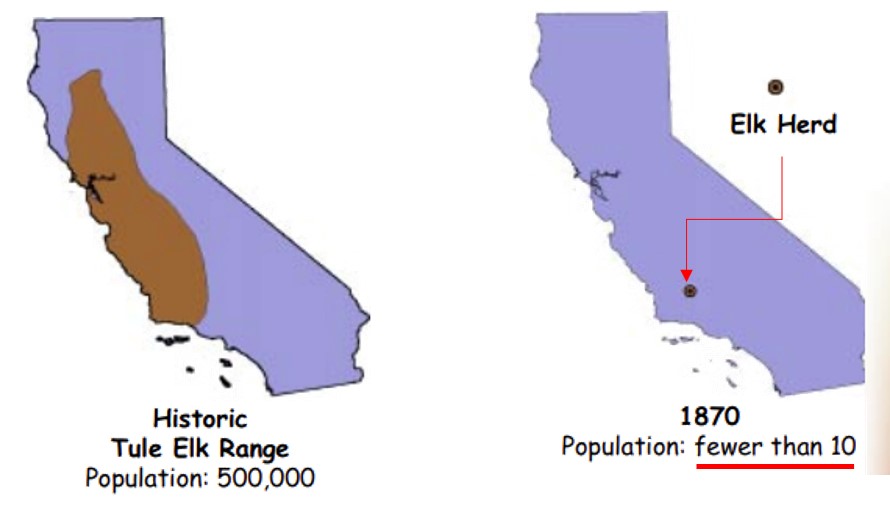
Data from: Linse, Kim. “Tule Elk – The Return of a Species.” National Parks Service, 1998.
Current Status – Fighting for Survival
In 1971, people began to take action to protect the elk. Tule elk received official protection in California State Senate Bill 722 (Peter Behr). It prohibited the hunting of Tule Elk — then numbering 500 — until their population reached 2,000 (which it did in 1989).
In 1976, Public Law 94-389 directed the federal government to make suitable lands available for “the preservation and grazing of Tule Elk.” Two years later, ten Tule Elk were moved to Tomales Point in Point Reyes National Seashore. It is a wonderful national park where I often go to see the elk.
As of 2025, there is thought to be around 5,700 Tule Elk throughout California. This is a far cry from fewer than ten in 1870!

Data from: Linse, Kim. “Tule Elk – The Return of a Species.” National Parks Service, 1998.
New Hope
In 2025, California took further steps to help the Tule Elk.
On Oct 29, 2025, California returned 17,030 acres of ancestral land to the Tule River Indian Tribe. As part of the land return, Tule Elk were reintroduced to the area.
In August 2025, California granted $2.7M to environmental groups to plan an ecological restoration of Point Reyes National Seashore and eventual free range of Tule Elk.
These two acts provide hope for the Tule Elk, and a future where we can see them often on our hikes.
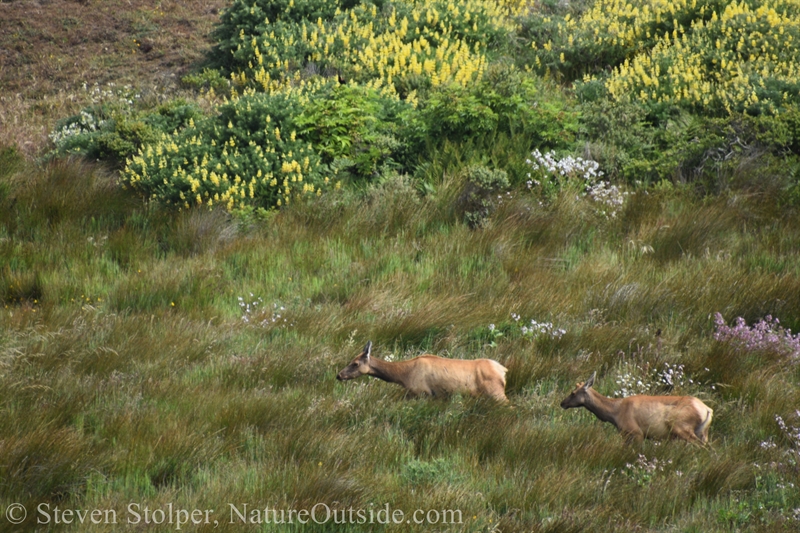
An elk family approaches a water hole.
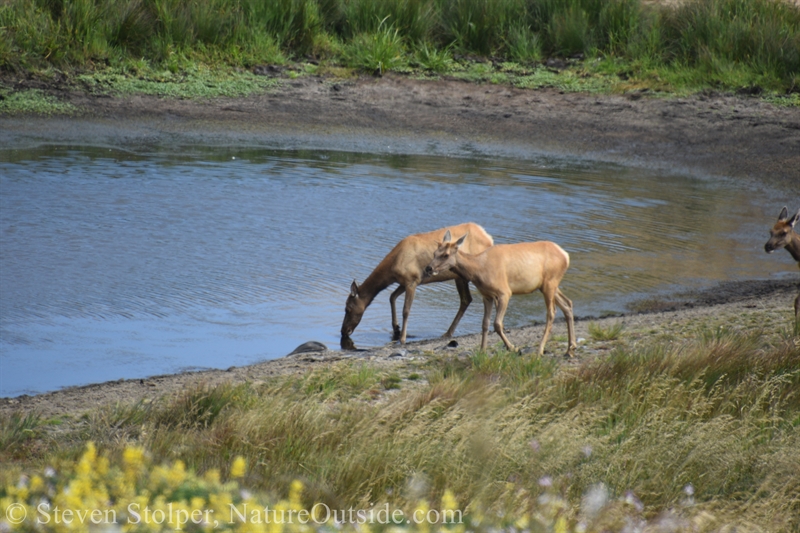
Tule Elk drinking at a water hole at Point Reyes.
Where You Can See Them
If you ever visit the San Francisco Bay Area, here is where you can see Tule Elk.
- Point Reyes National Seashore
- Máyyan ‘Ooyákma – Coyote Ridge Open Space Preserve
- Joseph D. Grant Park
- Anderson and Coyote Lake Harvey-Bear
- Motorcycle Park
- Hellyer County Park (rare)
They are magnificent animals that are thrilling to see from a hiking trail. And their continued presence shows that people can make a difference to the wildlife around us, when we are willing to make an effort.
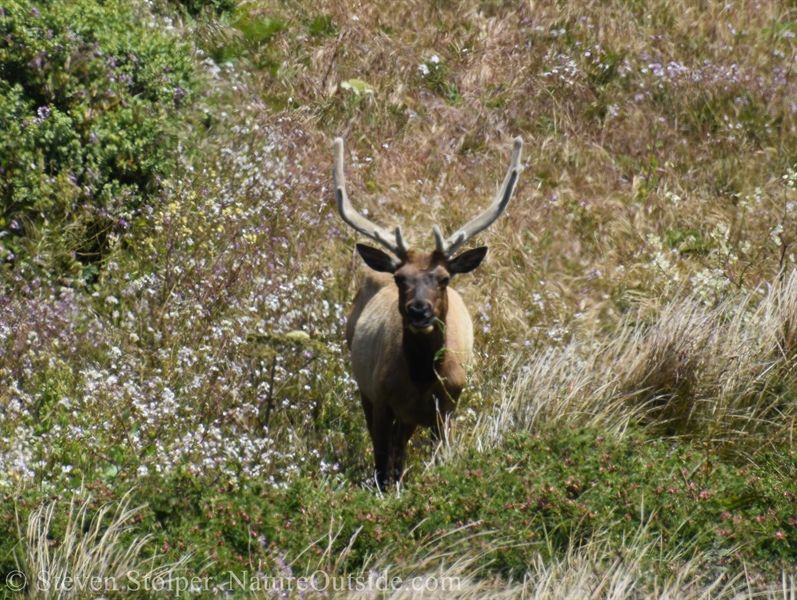
Tule Elk male.
Bibliography
Arnold, Caroline, and Richard Hewett. Tule Elk. Carolrhoda Books, 1989.
“Tule River Indian Tribe of California Reclaims over 17,000 Acres and Reintroduces Tule Elk on Ancestral Land | Governor of California.” Governor of California, 29 Oct. 2025.
Dusseault, Ruth. “State Grant Launches Point Reyes Restoration Design, Free-Range Future for Native Tule Elk.” Local News Matters, 13 Sept. 2025.
Linse, Kim. “Tule Elk – The Return of a Species.” National Parks Service, 1998.
“Tule Elk – Point Reyes National Seashore (U.S. National Park Service).” National Parks Service.
“Tule Elk | Santa Clara County Parks | County of Santa Clara.” Santaclaracounty.gov, 2025.
Related Articles
Happy Holidays Hike – Tule Elk at Point Reyes
I Saw a Whale While Hiking… And No, I haven’t Been Drinking!
Stalking the Black Bear – High Adventure in the Forest (Part 1)
For fun facts and useful tips, join the free Bushcraft Newsletter.


Leave a Comment