
I take a moment to lift my eyes from the ground. Mist drifts through the forest of Tanoak and California Bay. I’m surrounded by the drip, drip, of water falling from the branches above. The forest canopy shields me from the rain. But the cold, humid air can make for an unpleasant hike. Fortunately, I’m well bundled – protected by a fleece pullover and my olive drab rain jacket. My eyes return to their search. Scouring the dead Tanoak leaves that carpet the ground in golden brown.
I’m not alone. I’m with the West Valley College Biology Club. The club sponsored this herpetology walk in the Santa Cruz Mountains. And although I’ve walked this trail before, I look with new eyes as we search for ‘herps.’ Our group consists mostly of college students between the ages of 18 – 26. There are a few older students, like me. One has brought his wife and small child on the walk.
We are being led by Brandon Kong, a PhD Student in Animal Behavior at UC Davis. Brandon is a herpetologist, and a graduate of West Valley. Herpetology is the branch of zoology concerned with reptiles and amphibians. And we are hoping to find reptiles of different types among the leaf litter, rocks, and fallen branches.
How to Search for Herps
As we walk, we keep our eyes peeled for movement among the leaf litter. Many of the amphibians we seek are colored to blend into the leaves. We turn over rocks and fallen branches, hoping to find animals sheltering in the moist environment underneath.
When you turn over a rock or branch, you always pull the far end toward you. This keeps it between you and whatever lurks below. It’s a sensible precaution against an unpleasant surprise from a venomous reptile or spider.
After turning over a rock or branch, we carefully replace it exactly where it lay. We do this to maintain the moist habitat below it. If we were to put it back in a different spot, we could destroy the ideal moist habit that some animals need.
The Slender Salamander
I spot something I think is a small scat on a fallen tree. But others have sharper eyes than mine. It turns out to be Slender Salamander (Batrachoseps attenuatus). This tiny salamander has a long body and short legs. So it undulates like a snake when it walks. Adults are supposedly 3 – 5 1/2 inches ( 7.5 – 14 cm) in total length. But I rarely see them greater than three inches long.
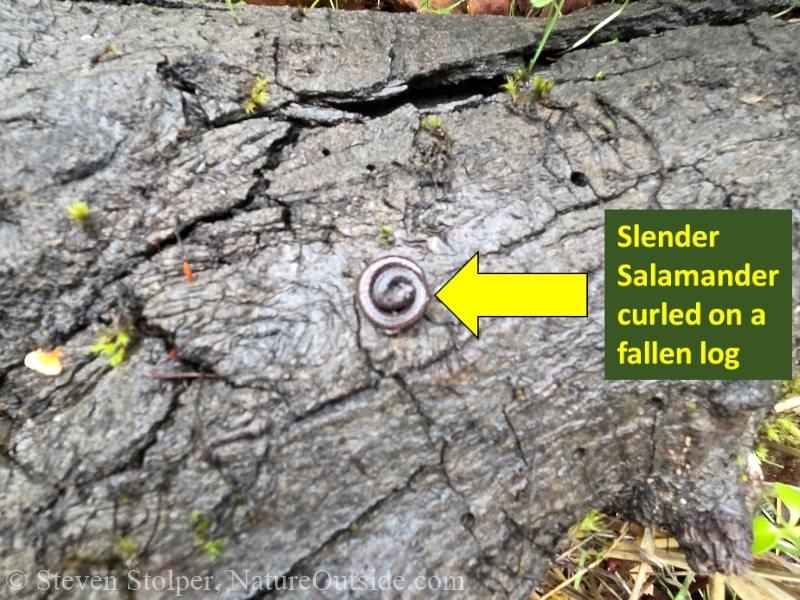
Slender Salamander curled on a fallen tree trunk.
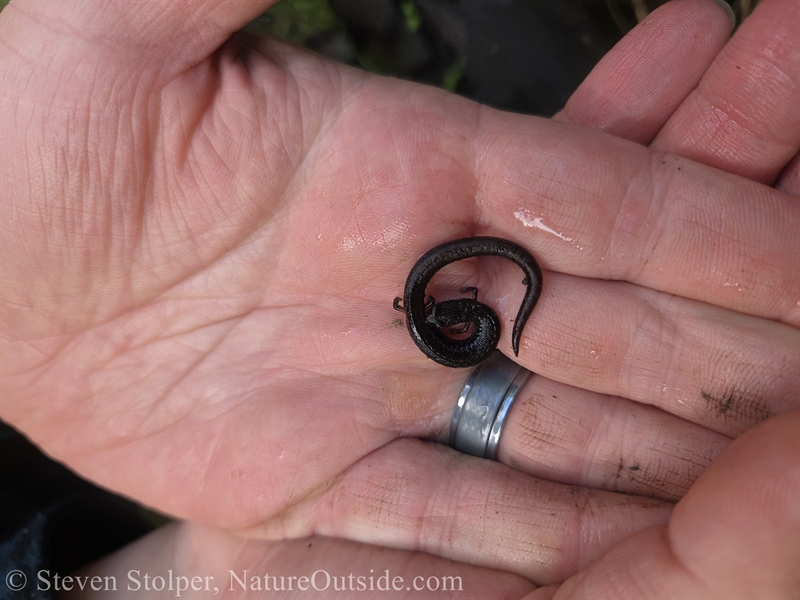
The Slender Salamander is tiny.
Handling Salamanders
Before we pick up a salamander, we wipe the palms of our hands on the wet ground. We want to have a coating of water on our hands.
Salamanders and many amphibians have permeable skin. And the oils found naturally in our hands can have negative effects on amphibians. The Slender Salamander, for example, does not have lungs. It respires through its skin and the tissues lining its mouth. So oils from our hands can affect its breathing.
We handle these creatures gently and for a short amount of time.
The Amazing Red-Bellied Newt
The quiet patter of falling rain continues as we walk. I love walking in the woods. On each journey I meet new friends or become reacquainted with old ones. And no matter how often I’m in the woods, Nature still has the power to astonish.
It isn’t long before I spot a newt crawling on the forest floor. At first, I mistake it for a California Newt. I’ve written before about these amazing creatures. But this newt is shockingly different.
It is a Red-bellied Newt (Taricha rivularis)! And this is the first one that I have ever seen.
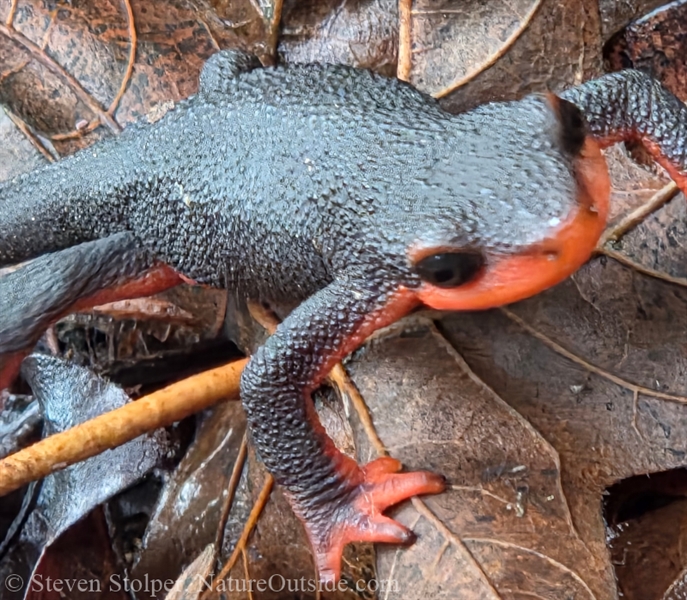
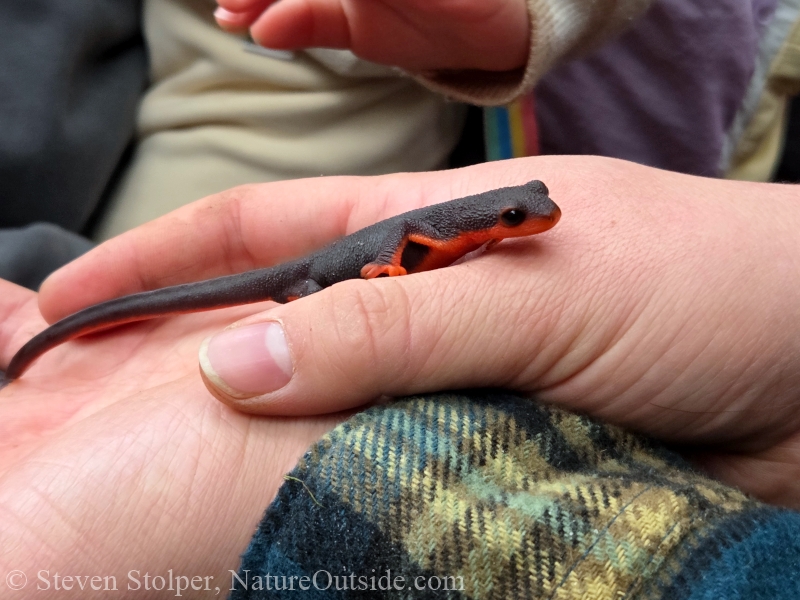
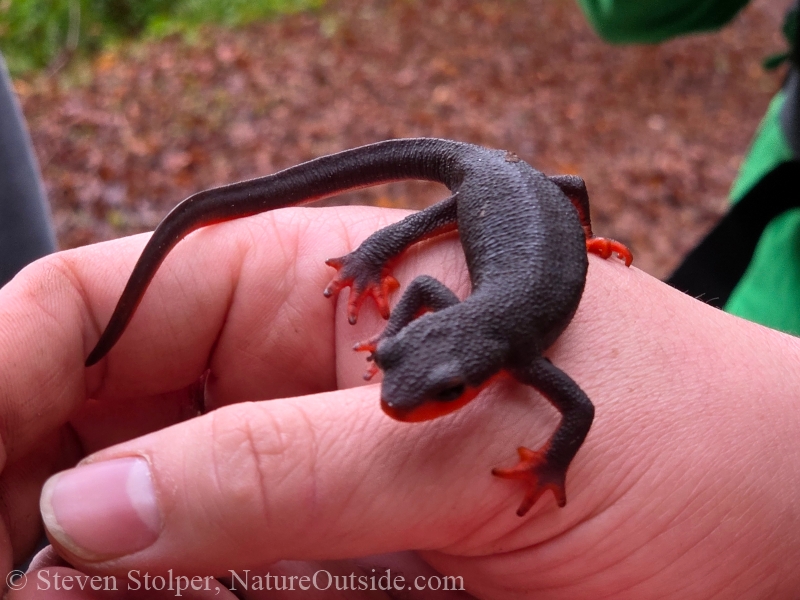
It has a dark brown back, almost black, with a slightly bumpy texture. This is just like the California Newt. But it’s stomach makes me double-take. It’s bright tomato red like the most garish crimson neon sign in Las Vegas. I have only seen this color in man-made products. I had no idea that Nature’s palette could pull off this trick. It is the neon red of a fancy sports car.
The color is mesmerizing. But it has a purpose. The deep red belly is nature’s way of saying, “I’m not on the menu”—what biologists call aposematic coloring. And it’s not bluffing. Red-bellied newts pack tetrodotoxin, the same neurotoxin found in pufferfish. The poison is widespread throughout the skin, muscles, and blood. It can cause death in many animals, including humans, if eaten in sufficient quantity.
The poison can also be ingested through a mucous membrane or a cut in the skin, so I take great care when handling newts. And I always wash my hands afterwards — especially before eating lunch!
The Red-bellied Newt (Taricha rivularis).
Its tiny dinosaur feet grip the wet leaves, and its beady dark eyes stare into the middle distance. Other newts have yellow around their eyes. These are jet black orbs.
It stops moving, waiting for me to move on so it can get back to newt business.
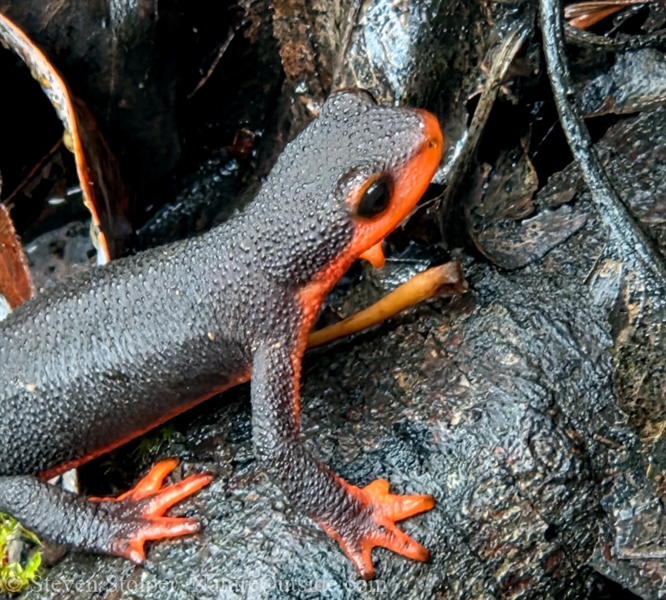
This newt, like our California newts, is a stocky medium-sized, salamander with grainy skin, and no costal grooves. Adults are around 5 1/2 – 7 1/2 inches (14 – 19.5 cm) in total length.
Unlike the Slender Salamander, Red-bellied Newts breathe through lungs.
During our rainy season, adults emerge from their rains lairs to feed for a period before migrating to a stream to breed. Non-breeding adults continue to forage on the forest floor. While typically nocturnal, the newts are active in daylight during the breeding season and during rains.
During our dry summers, they shelter in moist habitats under woody debris, rocks, and in animal burrows.
A Built-In Warning Label
The newt’s arch enemy is the Garter snake. Scientists believe we are witnessing an evolutionary arms race between them. As Garter snakes become more resistant to the tetrodoxin, the newts become more toxic.
When threatened, the newt assumes a swaybacked pose (unken reflex), to expose its brightly colored belly. This warns potential predators that the newt is poisonous.
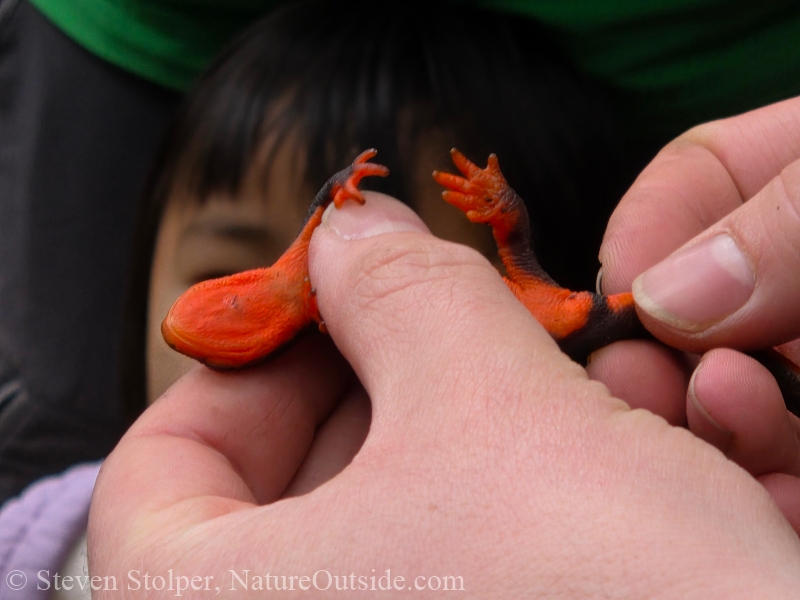
The Red-bellied Newt has a shocking red belly
Mystery Newts?
Prior to seeing one, I had not heard about the Red-bellied Newt. And that is because they may not be native to the Santa Cruz Mountains. They generally live along the California Coast in Sonoma County, more than 80 miles north of where I stand.
This is an isolated population. They live along the trail I’m walking and nowhere else in these mountains. And that is why I’ve never seen or heard of them before.
The population was apparently discovered by a trail runner in 2009. And they are genetically identical to the population in Sonoma. This raises questions. But apparently the Red-bellied Newt has the lowest genetic diversity of any coastal California salamander species, so researchers are unable to determine if this population is natural or introduced.
One theory of how the newts got here is that they were released by students of a local researcher. Stanford University biologist Victor Twitty (who first described this species in 1935) performed experiments on newts in the genus Taricha, including Red-bellied Newts. The proximity of Twitty’s Stanford lab to the Santa Cruz Mountains leads to speculation that perhaps he or his students introduced the newts to this location.
However they got here, they are amazing to see.
References
California Herps – Red-bellied Newt
Mystery of the Red-bellied Newt
California Herps – Slender Salamander
Related Articles on NatureOutside
What in the World is an Ensatina?
Urban Creatures – The Amazing Garter Snake
For fun facts and useful tips, join the free NatureOutside Newsletter.

We’re always looking for newts on the trail this time of year. They blend in so well with the leaf litter on the ground, it is often hard to spot them as we try not to unintentionally step on one! I didn’t know about the Red-bellied Newt either so will be on the lookout.
Thank you for always bringing some new and fun stories to your newsletter.
Ardis, I’m glad you enjoyed the article. And I hope you find a Red-bellied Newt. They are spectacular!