

Fizz was not happy to be out of her bucket. And she made her displeasure known. The high frequency buzz of an angry rattlesnake is unmistakable once you have heard it in the wild. Fizz is a female Northern Pacific Rattlesnake. Although raised in captivity, she is not used to being handled.
Professor Emily Taylor gently guides Fizz into a snake restraining tube. Transparent polycarbonate “snake tubes” safely hold snakes for handling, medical procedures, and viewing.
Professor Taylor is Director of the Physiological Ecology of Reptiles Lab (PERL) at Cal Poly, San Luis Obispo. She studies the environmental physiology of reptiles – how their bodies and their environment interact.
I manage to capture this moment (poorly) with my cellphone.
Everyone attending the Wildlife Fair at a local college was mesmerized by the snake.
My History with Snakes
Snakes are not my favorite animals. It started when I was five years old and living in Tallahassee, Florida. A friend and I decided to climb a tree near the apartments where my family lived. I stood at the bottom of the tree, bracing myself against its trunk, as my friend climbed to the top. I gazed upwards, following his progress. I suddenly sensed movement below me. And I glanced down to see a venomous Copperhead (Agkistrodon contortrix) slither between my legs. The Copperhead is a pit viper, endemic to eastern United States. I was too young to recognize the snake. But luckily I froze with fear. It slithered away and I was safe.
Years later I was hiking on the island of Tasmania with a local guide. Before I realized it, he reached down and fetched up a Tiger Snake (Notechis scutatus). It is a large and highly venomous snake that lives in southern Australia.
“Would you like to pat it?”
I considered my reply. Prior to the development of specific antivenom, Tiger Snake bite fatalities were at 60-70% with severe envenomation. And while death can ensue in as short as 30 minutes, more commonly death occurs within 6-24 hours. I would have a fighting chance to make it to a medical facility.
On the “pro” side, I could be one of the few people in the world to pet a wild Tiger Snake and live to tell the tale. On the other hand, an accidental slip by my guide and I would become a cautionary tale.
I passed on the opportunity. The snake was unlikely to escape his grasp. But the consequences for me would be life changing/ending.
But part of me felt like a failure for backing down from the snake.
Petting the Rattlesnake
Nearby, the professor’s two assistants held a Gopher Snake (Pituophis catenifer) and a California King Snake (Lampropeltis californiae). Both are nonvenomous and well-behaved when raised in captivity. Yet I politely declined their offer to pet them. Another snake fail.

California King Snake (L) and Gopher Snake (R)
Once in the snake tube, Fizz was no longer a threat to human life. But the snake rattled away like someone using a maraca at a salsa dance.
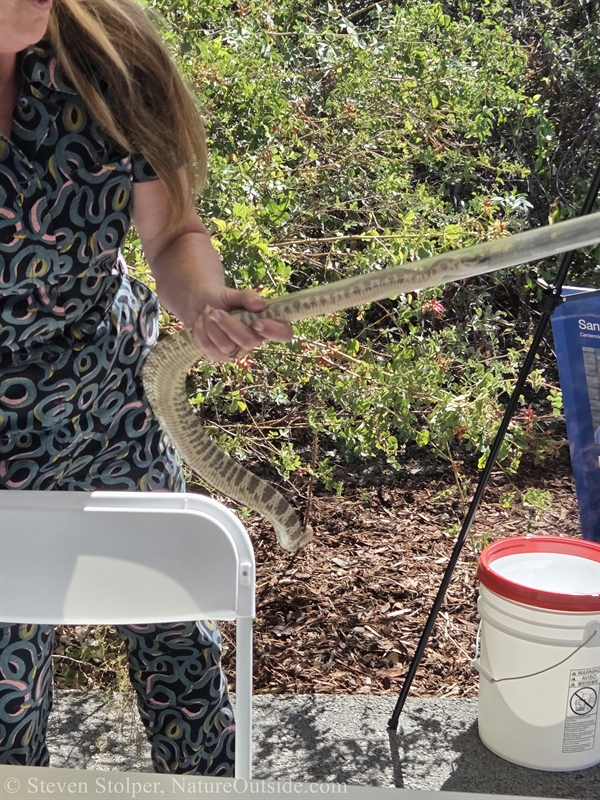
Once in the snake tube, Fizz was no longer a threat.
Professor Taylor then announced we could line up to pet the snake, as long as we did not touch the rattle. The rattle is made from fragile dead skin. And it can break off if handled roughly.
I have had my own dangerous encounter with rattlesnakes. So I hesitated.
Do I or don’t I? I waited until others had gone and the snake (and I) seemed slightly calmer. I reached out slowly, convinced that I was overriding millions of years of evolutionary instinct meant to preserve my well-being. Meanwhile, Fizz seemed profoundly uninterested in my existential moment. She was too busy rattling away.
I touched it.
It felt like… a snake. I’m always amazed by how firm and taut their bodies are. Underneath the sandpaper like texture is lean muscle. I am careful to stroke from head to tail. This is how it moves across the ground and its scales are shaped for this type of motion.
One small step for a man…
Before I depart, I take a photograph of my newfound friend. Some people fear flying. I’m unsettled by snakes. So I’m strangely self-satisfied by this small accomplishment.
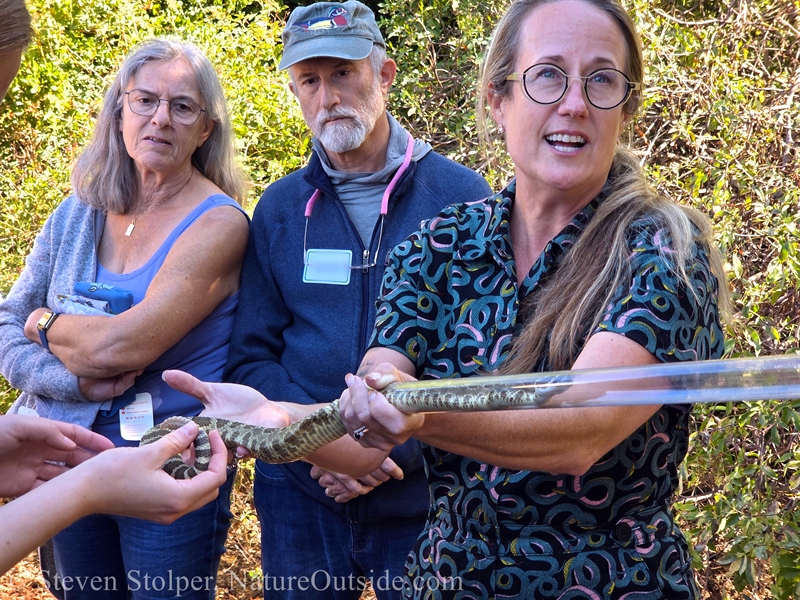
Fizz the rattlesnake in the tube.
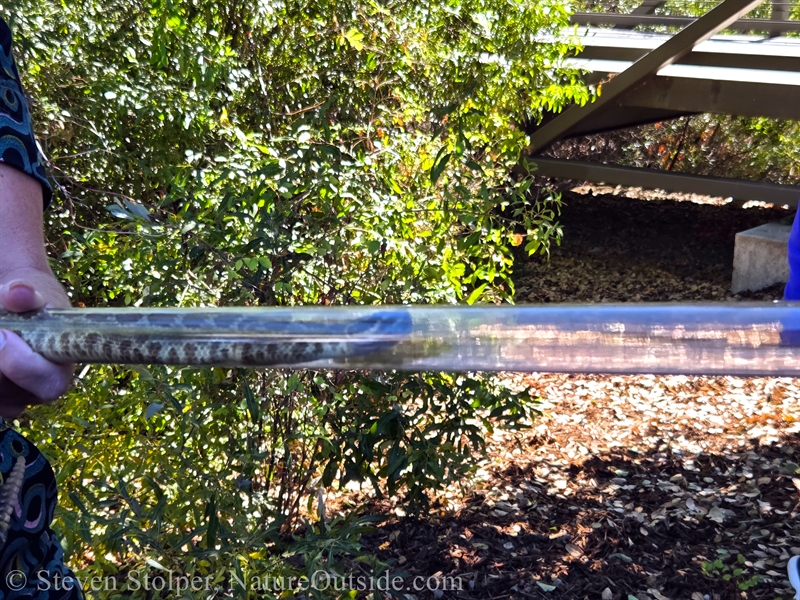
Thank you, Fizz!
The Professor’s Books
Professor Taylor has two new books out (as of this writing). You can use the affiliate links below to get them (or click on the images).
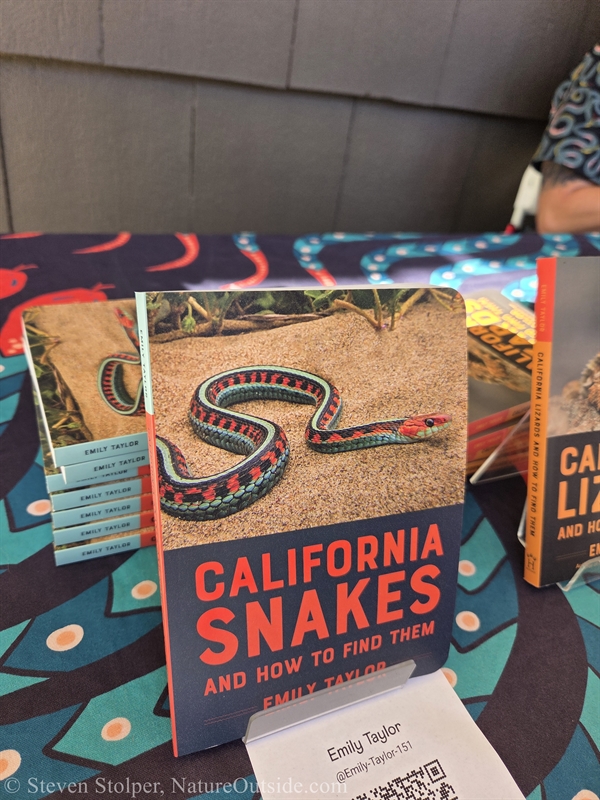
Click image to purchase on Amazon.
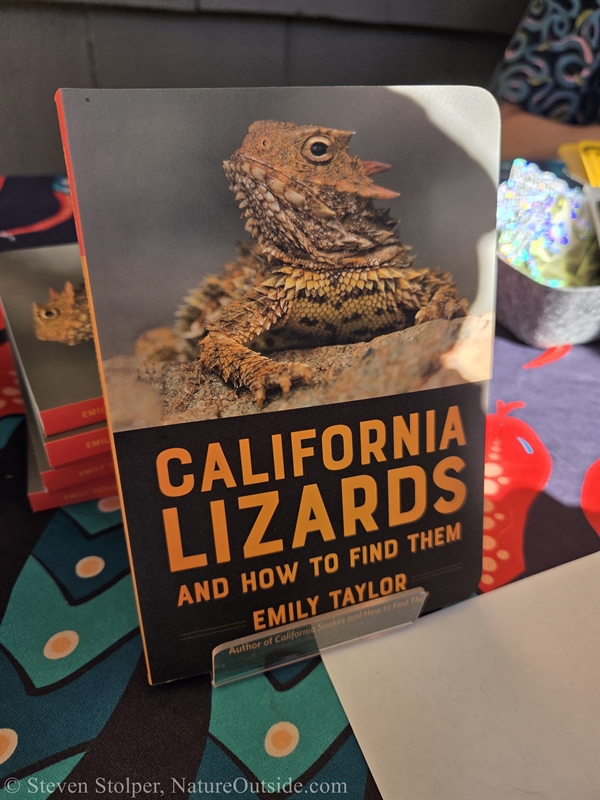
Click image to purchase on Amazon.
Related Articles on NatureOutside
Mountain Kingsnake – Beauty and Danger!
For fun facts and useful tips, join the free Bushcraft Newsletter.


As a retired faculty member and current part-time student of West Valley College, it would have been appreciated for the “local college” to be named in your post and hashtags. West Valley does a tremendous job in outreach and is a frequent host of events like this that are free to the public and I feel it deserves a proper shoutout.
It was fun to handle all the snakes, for sure, but touching a rattler was a highlight for me too.
Thank you for your comment, Betty! West Valley is indeed a marvelous academic institution.
There are three reasons I chose the phrasing the way I did.
I didn’t want to draw attention to West Valley allowing people to pet a live rattlesnake. I am concerned that an overzealous administrator might freak out about a “potential liability” and prohibit it in the future.
I also featured West Valley students in my last article. I chose not to have back-to-back articles promoting West Valley.
And finally, although the captive born snake is living a wonderful life, I did not want to risk any blowback on West Valley if readers reacted negatively to the use of the snake tube.
I hope this explanation helps!
Steve, thanks for sharing your reasoning.